
In this guide
In almost every flat and villa we work on in Hyderabad, the pooja room exists on the architect's drawing as a niche, a shelf, or a small dedicated room — and then disappears from the lighting drawing entirely. It inherits whatever the electrician had left over. That is a shame, because it is one of the few spaces in a home used at a fixed time every single day, in low light, where the quality of the light genuinely changes how the space feels. This article is part of our wider coverage of home automation in Hyderabad, and it deals specifically with getting the pooja room right before the carpentry and the ceiling close.
Why most pooja rooms are lit badly
Four failures account for nearly all of them, and each one is fixable on a drawing.
- One light, in the wrong place. A single downlight in the centre of the ceiling puts the light behind the person praying. Their own body casts a shadow straight onto the idols — the exact thing you wanted lit.
- Cool white light. 4000K or 6500K sources are the single most common error. Brass, copper, gold leaf, silk and marigold all depend on warm light with strong red content to look rich. Under cool light they go grey and metallic.
- Cheap, low-CRI fixtures. A budget LED with CRI 70 has almost no red in its spectrum. Vermilion, turmeric, flowers and the wood of the mandir all lose their saturation.
- Lighting placed with no thought for flame. A profile light or driver mounted directly above where diyas and camphor burn will discolour, yellow and fail — often within a year — and it is then buried inside finished carpentry.
None of this is expensive to solve. It costs almost nothing to fix on a drawing, and a great deal to fix after the woodwork is polished.
The three layers a pooja room needs
Even a compact 4ft x 4ft niche wants three separate, separately dimmable circuits. The same three-layer logic we apply to a living room applies here at a smaller scale.
1. Accent — the layer that matters most
Two to three narrow-beam spots, typically 5–7W each, aimed at the idols from the front-top at roughly a 30° angle from vertical. Front-top is the key: it lights the faces of the idols without the worshipper's shadow falling across them, and it keeps the light source out of direct eye line when seated. This is the layer that makes the mandir look intentional rather than merely visible.
2. Mandir / shelf light
A concealed warm strip, roughly 400–600 lumens per metre, tucked behind a lip inside or immediately above the mandir shelf. It fills the interior of the unit so the back panel and carving are not a black void, and it is the layer you leave running low all night. Keep the strip in an aluminium profile with a wipeable frosted diffuser — pooja rooms accumulate oil and soot film, and a bare strip is impossible to clean.
3. Ambient — for the standing area
One soft, diffused source of roughly 400–700 lumens for the space where the person actually stands or sits, ideally set slightly forward of the mandir rather than behind it. In a dedicated room this can be a small cove; in a niche within a corridor it may be a single wide-beam downlight a foot or two in front of the opening. Keep it dimmable — at aarti you want it up, at 10pm you want it nearly off.
If you want the full reasoning behind layering, our guide to living and dining room lighting layers works through it at room scale, and panel vs COB vs strip vs spot lights covers which fixture type belongs where.
The numbers: lumens, CCT, CRI and beam angles
These are the specifications worth writing onto the drawing rather than leaving to the site.
- Colour temperature: 2700K, and 2400K–2700K on the idols. This is not a stylistic preference — it is what makes brass look like brass. Never specify above 3000K inside the niche. Tunable fixtures are the better answer: the room can sit at 3000K for cleaning and daytime, and drop to 2700K for aarti and evening. We explain the ranges in our colour temperature (CCT) guide and the control side in tunable and dimmable lights.
- CRI 90+, and check R9. CRI 90 is the floor. More specifically, ask for the R9 value (deep red) to be above 50 — that single number is what carries vermilion, marigold, red silk and warm skin tones. Most cheap LEDs have an R9 near zero.
- Beam angle: 15°–24° for accent spots. Narrow beams keep the light on the idols instead of spilling onto the ceiling and walls. Use 24° for a wider mandir unit, 15° where you want a single deity picked out. For the ambient layer, 60° or wider. Our guide to downlight spacing and beam angles covers the geometry in full.
- Contrast ratio: aim for roughly 3:1. The idols should read about three times brighter than the surrounding wall. Much less and nothing stands out; much more and it looks like a stage set.
- Total output. For a 4x4ft to 6x6ft pooja space, the three layers together typically land around 1,200–2,000 lumens at full. This is deliberately lower than a living room — a pooja room lit to living-room levels loses its atmosphere entirely.
- Glare control. Use deep-recessed or honeycomb-louvred spots. In a small room, a shallow-set spot is directly in your eye line when you stand, and glare is the fastest way to make a space feel uncomfortable.
Heat, soot and diya clearances
This is the section most lighting guides skip, and it is the one that decides whether the installation still looks right in year three.
- 300mm minimum clearance. Keep every fixture, profile and driver at least 300mm away from — and never directly above — the position where diyas, agarbatti or camphor are lit. Soot plumes rise straight up; anything above the flame line will yellow.
- Sealed or glass-fronted fixtures near the flame zone. An open aluminium profile with an exposed diffuser collects oil film that cannot be cleaned off. A sealed fixture with a flat glass face can simply be wiped.
- Drivers outside the niche, always accessible. LED drivers fail long before strips do. Sealing a driver inside finished pooja carpentry turns a small component replacement into a joinery job. Leave it in a reachable service point — above a wardrobe, behind a removable panel, or in the false ceiling with a hatch.
- Ventilation matters. A closed pooja cabinet with lighting inside and no airflow runs hot, and heat is what shifts LED colour and shortens life. Leave a vent gap at the top of the unit or specify fixtures rated for enclosed installation.
- Plan the exhaust. If the room is enclosed, a small exhaust fan is worth a dedicated automated circuit that runs for a set period after the Aarti scene — it protects the lighting and the carpentry alike.
Scenes: morning, aarti, evening and night
A pooja room is used at predictable times, which makes it one of the best candidates for scene control in the entire home. Once each layer is its own dimmable circuit, this is a typical configuration we set up:
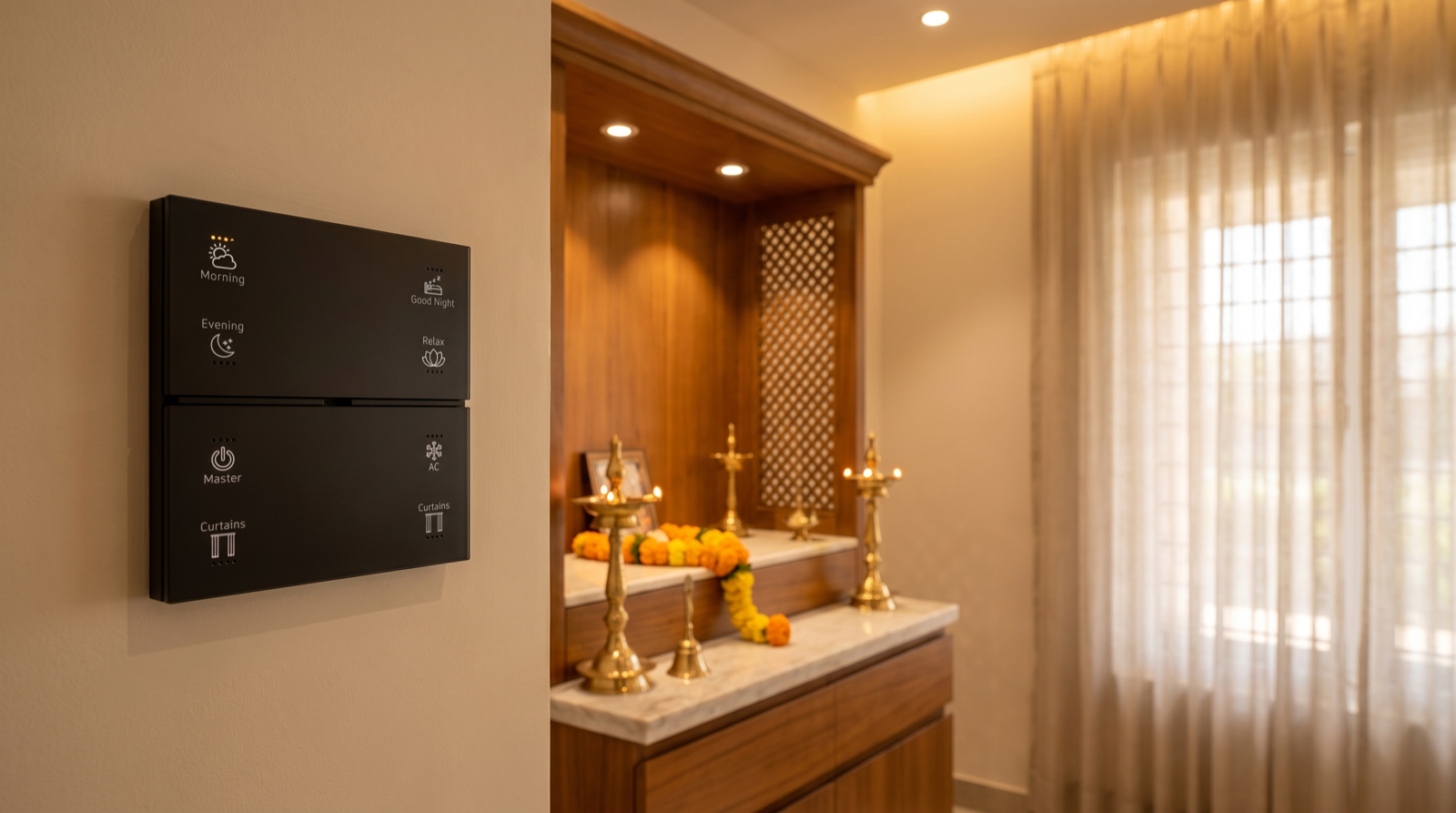
- Morning Prayer — accent spots at 80%, mandir strip at 70%, ambient at 60%, all at 2700K. Can be scheduled to fade up gently at, say, 6:00am so the room is ready.
- Aarti — everything at 100% and fully warm. One press, held for the duration of the ritual.
- Evening Diya — accent at 30%, mandir strip at 40%, ambient off. Low enough that the diya flame is the brightest thing in the room, which is the entire point.
- Night Glow — mandir strip alone at 5–10%, everything else off. Many families prefer the mandir never to be completely dark; a 5% strip does that for a negligible amount of power.
These belong on a wall keypad mounted just outside the pooja room door or at the niche, not buried in an app — the people who use a pooja room most are often the ones least interested in unlocking a phone first. That is the core argument in why scene-based automation beats app-only devices, and our worked examples of scene design shows how these link into whole-home scenes. A Morning scene, for instance, can raise the pooja lighting, open the motorised curtains in the living room, and disarm night security in a single press.
Getting all of this from dimmable, tunable smart lighting is what lets the same three fixtures serve a bright aarti and a 5% overnight glow without any rewiring.
Pre-construction checklist
If your pooja room carpentry is not yet built, take this list to your interior designer and electrician:
- Three separate dimmable circuits marked on the drawing — accent, mandir strip, ambient — not one common point.
- Accent spot positions dimensioned on the reflected ceiling plan, set forward of the mandir face and angled roughly 30° from vertical.
- A concealed lip or rebate inside the mandir unit deep enough to hide a profile and diffuser, typically 25–40mm.
- Driver locations marked outside the niche with a named, accessible service point for each.
- The diya and camphor position marked, with the 300mm no-fixture zone drawn around it.
- A control cable run back to the automation panel so each layer is addressable, plus a keypad point at the entry to the room.
- A ventilation gap or vent detail if the mandir is an enclosed cabinet.
- If there is a window, a curtain or blind point — many families want light control here too.
Reading the ceiling drawing itself is a skill worth having; how to read a reflected ceiling plan walks through it. And if you are working through a whole home rather than one room, start with how to plan smart lighting for a new home.
How Pert delivers it — a designed solution, not a DIY kit
Pert is a solutions company: we design and install, we do not hand over a box of parts for you to figure out. On a pooja room that means a site visit to measure the niche, the mandir unit and the standing position, a lighting layout that marks spot positions, angles, strip runs, driver locations and the flame clearance zone on the same drawing your carpenter and electrician work from, coordination with your interior designer before the joinery is finished, professional installation and commissioning, and then scene tuning done in the finished room in the evening — because a light level that looks correct on paper almost never looks correct at 7pm with a diya lit.
If you are adding this during a renovation rather than new construction, read can you add home automation during renovation in Hyderabad. And if you are still comparing providers, our guide to the best home automation companies in Hyderabad covers what to check before you sign.
Planning a pooja room in your Hyderabad home? Get the spot positions, colour temperature, flame clearances and dimming circuits designed before the carpentry is finished — it costs nothing to change on a drawing and a great deal to change afterwards. Request a consultation →
Frequently asked questions
What colour temperature is best for a pooja room?
2700K is the right anchor, and 2400K–2700K is better still for the light landing directly on brass and idols — warm light is what makes brass, gold leaf, copper and silk read as rich rather than grey. Never go above 3000K inside the niche. Tunable fixtures let the room lift to around 3000K for cleaning and daytime and drop back to 2700K for aarti.
How many lights does a pooja room need?
Three circuits, not one: two to three narrow-beam accent spots of about 5–7W aimed at the idols, a concealed warm strip of roughly 400–600 lumens per metre in or above the mandir shelf, and one soft ambient source of about 400–700 lumens for the standing area. A single central ceiling downlight is the classic mistake — it flattens the idols and throws the worshipper's own shadow onto the mandir.
Is it safe to put LED lighting close to diyas and camphor?
Only with planned clearances. Keep fixtures, profiles and drivers at least 300mm from — and never directly above — where diyas, agarbatti or camphor burn, since soot and heat will discolour a diffuser and shorten LED life quickly. Use sealed or glass-fronted fixtures near the flame zone, keep drivers outside the niche in an accessible location, and specify a wipeable diffuser.
Can a pooja room be put on scenes and automated?
Yes, and it becomes one of the most-used scenes in the house. Pert typically sets up a Morning Prayer scene that fades up at a scheduled time, an Aarti scene at full warm brightness, an Evening Diya scene at around 25–30%, and a 5–10% overnight glow so the mandir is never fully dark — all run from a wall keypad at the room entrance rather than from a phone.