
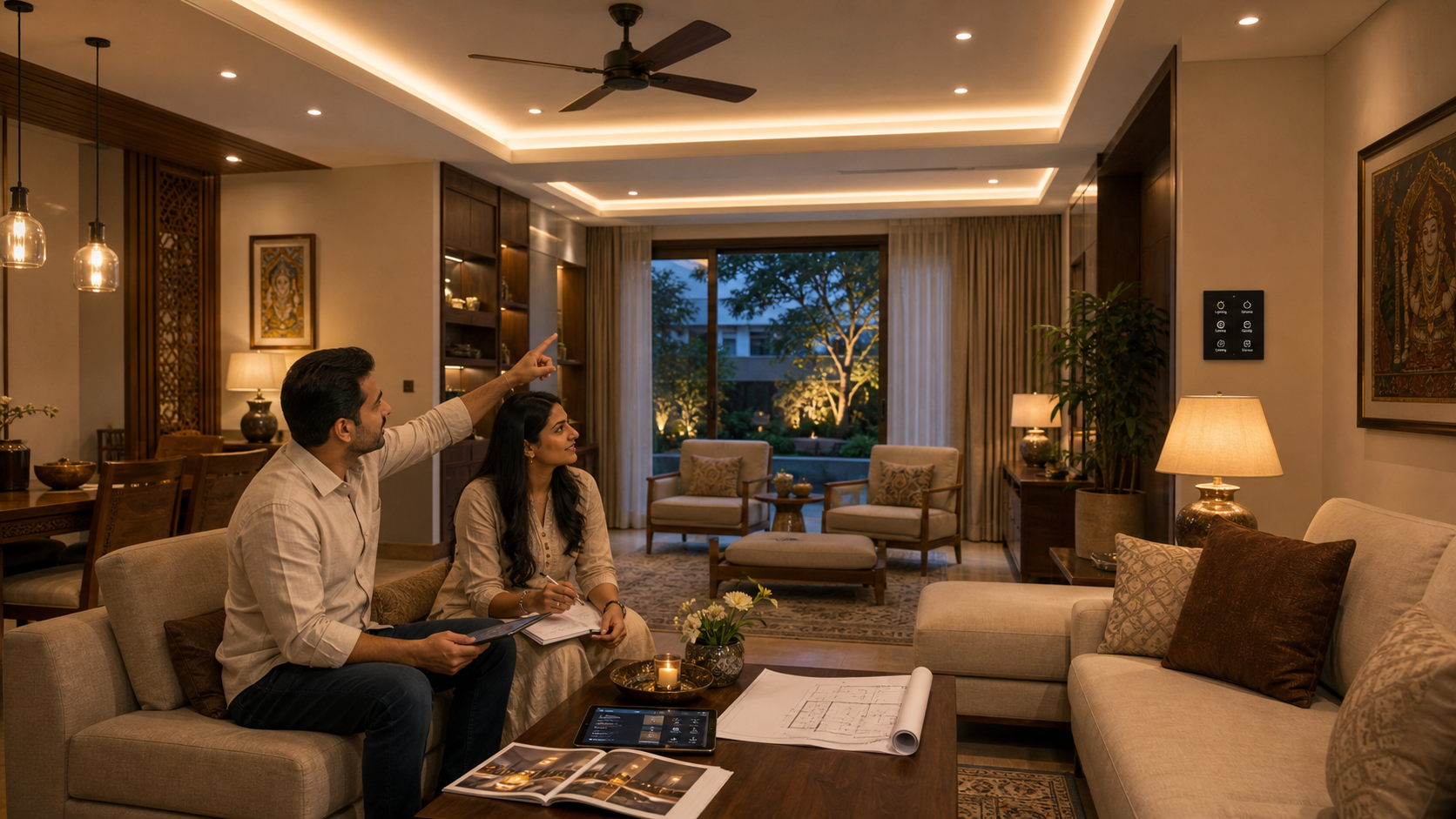
Among all home automation features, smart lighting usually creates the biggest visible difference. It changes mood, comfort, and usability every day. But many homeowners start too late, after switchboards are fixed and lighting zones are already compromised.
If you want the broader system view, read the main home automation guide. If you want to plan lighting properly from the start, use this framework.
Start with layers, not fixtures
Most poor lighting plans begin with fixture count instead of lighting function. Smart lighting should be thought of in layers:
- General lighting for base visibility
- Accent lighting for mood and emphasis
- Task lighting for reading, dressing, cooking, and focused activity
- Decorative lighting for visual identity
Once these layers are clear, scene planning becomes much easier.
Plan scenes before switch logic
Do not group circuits only by “what is near each other.” Group them by how the room should behave. Ask practical scene questions:
- What should Morning look like?
- What should Evening look like?
- What should Relax, Dining, Movie, or Night do?
These answers should shape the zoning. This is the core advantage of scene-based automation.
Different rooms need different lighting logic
The same smart-lighting plan should not be repeated blindly across all rooms.
- Bedrooms need soft, low-glare, dimmable night behavior and calm wake-up scenes.
- Living rooms need more layered shifts across relaxation, entertaining, and everyday use.
- Dining areas need warmer, more intentional scene control.
- Circulation spaces need simpler and often more automatic logic.
See Best Home Automation Ideas for Bedrooms, Living Rooms, and Dining Areas.
Dimming is often more important than adding more lights
Many homes add more fixtures when what they really need is better control. Dimming changes how rooms feel without increasing visual clutter. It makes lighting scenes useful instead of theatrical.
If you want a room to transition well between day and night, dimming should usually be part of the plan.
Keypad planning should happen with lighting planning
Lighting scenes are only as useful as the controls that trigger them. If the homeowner has to open an app every time, the system is already weaker than it should be.
Plan for:
- Entrance scene control
- Living room scene control
- Bedside keypad logic
- Dining and transition-area controls where needed
Read How to Plan Keypads in a Home and explore Stella.
Coordinate lighting with curtains and comfort
Lighting feels more complete when it is not acting alone. In many homes, the strongest scenes combine:
- Lighting level
- Curtain position
- Comfort or AC state
That is especially true for living rooms, master bedrooms, and large shared family spaces.
Plan early or expect compromises
Smart lighting should be discussed during architecture, electrical planning, or at the latest before interior electrical decisions are finalized. Late decisions create the usual problems:
- Weak zoning
- No dimmable provision where it matters
- Poor keypad locations
- Flat lighting scenes
- Extra rework
Read When Should You Plan Home Automation During Construction?.
What mistakes should you avoid?
- Using one lighting approach in every room
- Planning only for brightness and not for mood
- Ignoring dimming where scene quality matters
- Fixing switchboards before scene logic is defined
- Leaving keypad strategy until later
See Common Mistakes Homeowners Make While Planning Home Automation in Hyderabad.
Where to start if the lighting budget is phased
If the project is staged, prioritize lighting in this order:
- Living room
- Main bedroom
- Dining or family-use area
- Entrance and transition scenes
That gives the strongest visible improvement early.
Final thoughts
Smart lighting planning is not about adding more fixtures. It is about designing better lighting layers, better zoning, and better scenes before the home is built out. If that foundation is correct, the automation becomes natural instead of forced.
For product direction, explore smart lighting. For broader project planning, return to the main home automation guide.