
In this guide
- What circadian lighting means in a home — and what it does not
- The eight-stage schedule, with numbers
- Which rooms should follow the schedule, and which should not
- Overrides: the rule that decides whether it stays switched on
- Fixtures, drivers and channels it needs
- Six mistakes that make circadian lighting feel wrong
- How Pert delivers it (designed, not DIY)
- FAQs
This article is for homeowners and interior designers who already know they want tunable lighting and now need to decide what it should actually do. It sits within our wider coverage of home automation in Hyderabad. If you are still deciding which colour temperature suits which room in the first place, start with what CCT to use in every room of an Indian home — this guide picks up where that one stops, turning a fixed room-by-room choice into a schedule that moves through the day.
What circadian lighting means in a home — and what it does not
Circadian lighting, often sold as "human-centric lighting", changes two things together on a timeline: colour temperature (warm to cool, measured in Kelvin) and intensity (the dim level). Most homeowners focus on the colour, but intensity matters at least as much. A 4000K cove at 15% is a gentle, slightly cool glow; a 2700K downlight grid at 100% is still a lot of light at 10pm. A schedule that shifts only the Kelvin and leaves the brightness alone does half the job.
Three clarifications stop the idea being oversold:
- It is about light at the eye, not light on the floor. What affects how alert you feel is the light entering the eye from the walls, ceiling and screens around you. That is why indirect sources — cove, wall wash, wall lights — are the backbone of a good circadian scheme, and a ceiling full of downlights is a poor one.
- It does not replace daylight. Even a bright interior at 500 lux is a small fraction of outdoor daylight. The biggest morning benefit in any home still comes from opening the curtains, which is why the schedule and the motorised curtains should be designed together.
- The evening matters more than the afternoon. Research on light and sleep is most consistent about the pre-sleep window: bright, cool light late in the evening tends to delay the body's sleep signals. If the budget only allows a schedule in part of the day, get the sunset-to-bedtime stages right first.
We make no medical claims for any of this. What we can say from projects is simpler: homes where the evening light warms and dims on its own feel calmer after dark, and families stop asking why the living room "feels like an office" at 9pm.
The eight-stage schedule, with numbers
The schedule should be anchored to sunrise and sunset on an astronomical clock, not fixed times. In Hyderabad sunrise moves from about 5:45am in June to about 6:50am in January, and sunset from about 5:40pm in late November to about 7:00pm in early July — a swing of well over an hour. A fixed "warm at 6:30pm" timer is early in summer and late in winter. Bedtime stages, on the other hand, follow the household, so they are set as times and adjusted for weekends.
This is the default we start from for a living room and master bedroom, before tuning it to the family:
| Stage | Starts | CCT | Dim level (indirect / downlights) | Fade | Curtains |
|---|---|---|---|---|---|
| 1. Wake | Wake time − 20 min (bedrooms only) | 2700K rising to 3500K | 0% → 40% / off | 20 min | Sheers open at wake time; blackout 5 min later |
| 2. Morning | Sunrise, or wake time if later | 4000K | 60% / 50% | 15 min | Main layer open on non-west glass |
| 3. Day | Sunrise + 3 h | 4000K | 30% / off, or off where daylight is enough | 30 min | Sheers closed on east glass until noon |
| 4. Afternoon | 2:00pm | 3500K | 30% / off | 60 min | Sheers closed on west glass |
| 5. Sunset transition | Sunset − 30 min | 3500K → 3000K | rises to 50% / 30% | 45 min | Blackout or main layer closes at sunset + 15 min |
| 6. Evening | Sunset + 30 min | 2700K | 45–60% / 20–30% | 30 min | Closed |
| 7. Wind-down | Bedtime − 60 min | 2200–2400K (or lowest the fixture reaches) | 15–25% / off | 30 min | Closed |
| 8. Night path | Good Night press, or bedtime + 30 min | 2200K or amber | 1–5% on low-level path only | 10 s | Closed |
A few of these values are worth explaining.
Why the daytime peak is 4000K, not 6500K
Most tunable fixtures reach 6000–6500K, and it is tempting to use the full range at midday. In a home that almost always looks clinical, especially against warm wood, beige stone and ivory walls. 4000K reads as crisp daylight indoors; we reserve 5000K and above for a study or home office desk on overcast monsoon days, and even there it is a scene, not a schedule default. The home-office numbers are in how to plan home office lighting for work from home.
Why the light rises at sunset
Stage 5 is the one people find counter-intuitive: as the colour warms, the level goes up. Daylight is falling away, so the electric light has to take over to keep the room at a steady brightness. If both warmth and level drop at 6pm, the room feels as though it has suddenly gone gloomy. The drop in intensity belongs at stage 7, an hour before bed.
The wind-down numbers
For the last hour before sleep, aim for light at seated eye height below about 50 lux, off the cool end of the scale, with ceiling downlights off and cove or wall lights at 15–25%. That matches the sleep-window guidance in how to plan bedroom lighting and automation, and in the living room it has a useful side effect: it gently signals to the whole household that the evening is ending, without anyone having to say so.
Fade speed
Colour changes should be slow enough that nobody sees them happen. Moving 500K over 30 minutes is about 17K per minute, which is imperceptible in an occupied room; a 1000K jump in 10 seconds is very obvious and feels like a fault. As a rule, keep scheduled colour shifts below about 40K per minute and scheduled level changes below about 2% per minute. Scenes pressed on a keypad can be faster — 2 to 4 seconds — because the person pressing expects a change.
Which rooms should follow the schedule, and which should not
Circadian scheduling pays off in rooms people occupy for long, continuous stretches at different times of day. It is wasted, or actively annoying, in rooms with one job. Our default split:
- Follow the full schedule: living room, family lounge, master bedroom, parents' bedroom.
- Follow a modified schedule: dining (evening stages only, with the dining pendant held at 2700K), study and home office (stages 2–4 extended to the end of the working day, then straight to Evening), kids' rooms (study time at 4000K, then an earlier wind-down and a night tier — see how to plan kids' room lighting).
- Night stages only: corridors, staircase and bathrooms, which should switch to a 2200K, 1–5% night mode after bedtime and otherwise stay at a fixed neutral CCT.
- Fixed CCT, no schedule: kitchen work surfaces (3500–4000K for accurate food colour and knife safety), utility, wardrobes, store rooms and the pooja room, where the warm setting is a deliberate design choice rather than a time of day.
Two households deserve special attention. For elderly parents, a slightly brighter morning and daytime (70–80% rather than 60%) helps with visibility, and the night path matters more than the wind-down — the safety side is covered in home automation for elderly parents. For shift workers or night owls, a bedroom schedule tied to sunrise is wrong; tie their bedroom stages to their own wake and sleep times and leave the shared living spaces on the sun.
Overrides: the rule that decides whether it stays switched on
The most common reason circadian lighting gets switched off is not the colour. It is the automation fighting a person. Someone presses Movie at 8pm, and ten minutes later the schedule quietly raises the cove back to Evening. Someone turns the study up for a late assignment, and the wind-down stage dims it at 10pm. After two or three of those, the family asks for the schedule to be removed.
The rules we commission to prevent that:
- Any manual press pauses the schedule for that room. A scene from a wall keypad, a dimmer adjustment or an app change puts the room in manual.
- The pause ends at the next stage boundary, or after 2–3 hours, whichever is later — not immediately and never mid-film. A Movie scene should hold until it is ended or the room goes Good Night.
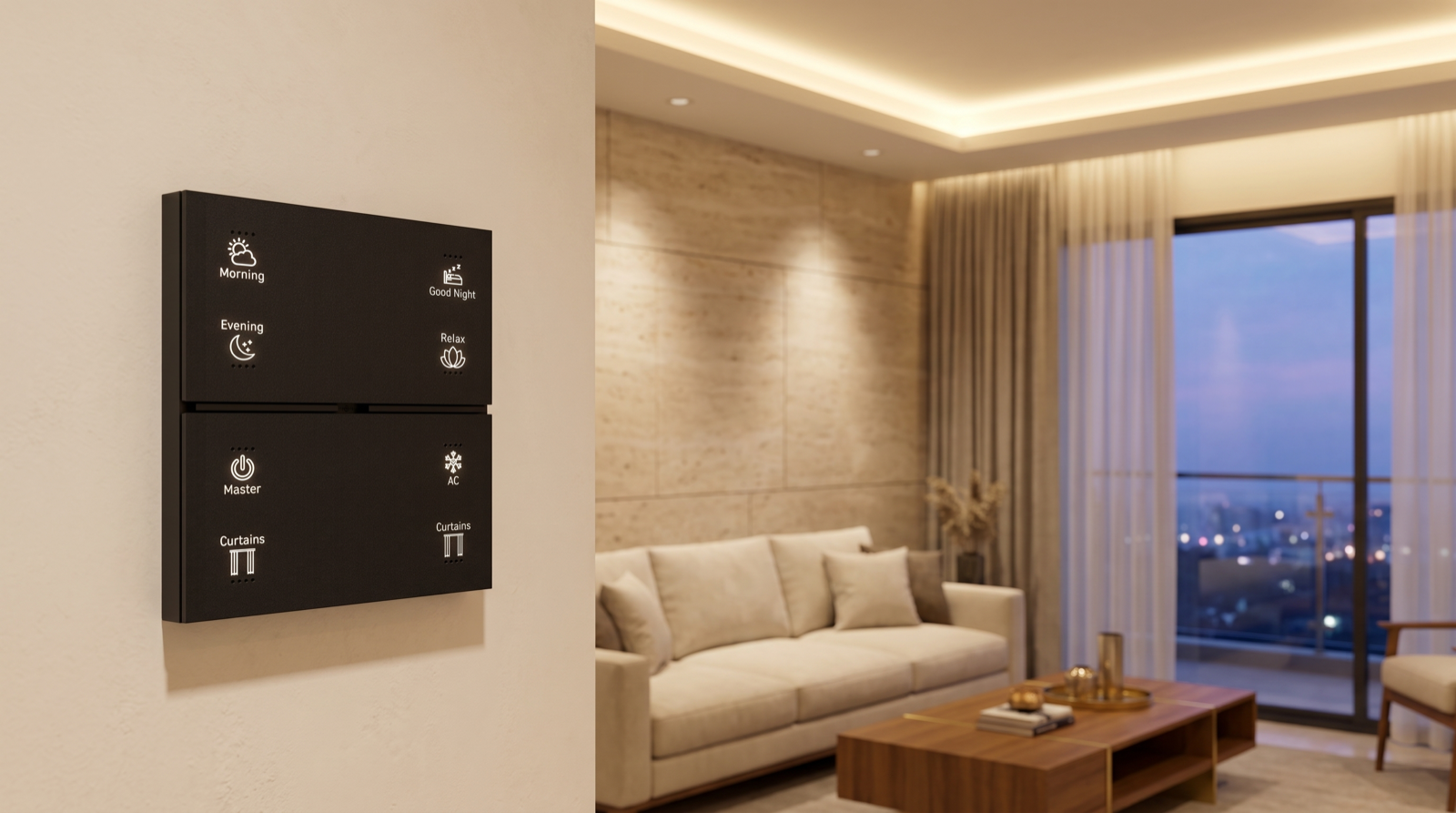
- Returning to automatic is one press. An engraved "Auto" or "Day" button on the main keypad, or simply pressing the room's Evening scene, hands the room back to the schedule and fades to wherever the schedule would now be.
- Scenes stay in charge of level; the schedule can stay in charge of colour. On many projects the best compromise is that scenes set brightness and on/off, while the schedule keeps adjusting CCT underneath. Pressing Relax at 4pm gives a 3500K Relax; pressing it at 10pm gives a 2400K Relax.
- Weekends get a later wake stage. A 6:10am bedroom sunrise on a Sunday is the fastest route to the whole feature being disabled.
Rule 4 is worth planning into your scenes from the start. How we write scene values, fade times and triggers is set out in how to design home automation scenes with worked examples.
Fixtures, drivers and channels it needs
A schedule is only as good as the hardware underneath it. Before signing off a tunable lighting package, check these:
- Genuine tunable white fixtures with separate warm and cool LED channels, typically 2700–6500K. Some ranges start at 2200K, or add dim-to-warm behaviour; for stage 7 and the night path, a fixture that reaches 2200K is noticeably better than one that stops at 2700K. Pert's tunable COB, strip and spot lighting is specified for exactly this.
- CRI 90 or better at both ends of the range, not just at the midpoint on the datasheet. Cheap tunable fixtures often look grey or greenish at the cool end and muddy at the warm end. What CRI, R9 and binning mean on a spec sheet is covered in LED light specs explained.
- Consistent output across the mix. Some fixtures lose noticeable output when running at a 50/50 warm-cool mix, so a 3500K afternoon looks dimmer than the 4000K morning at the same level. Ask for a constant-lumen driver or test a sample at three CCT points.
- Two control channels per tunable group, or a tunable driver protocol that carries colour and level on one address. This roughly doubles the channel count against fixed-CCT lighting, and it has to be in the controller and wiring plan before the false ceiling closes. How to count and load those channels is in how to plan dimmer channels and lighting loads.
- Flicker-free dimming to 1%. Stage 7 and the night path live at the bottom of the dimming curve, which is exactly where poor drivers flicker, step or buzz. See why LED lights flicker when dimmed.
- Separate circuits for indirect and direct light. Cove and wall wash on one group, downlights on another, so the schedule can run them at different levels. A room with everything on one channel cannot do stages 6 and 7 properly.
- A controller with an astronomical clock and local logic, so the schedule keeps running through an internet outage and restores correctly after a power cut instead of jumping to full brightness.
Six mistakes that make circadian lighting feel wrong
- Using 6500K as the daytime default. The home looks like a clinic by 11am.
- Scheduling every fixture, including accents. Artwork spots, pooja lights and the dining pendant should hold their designed colour; only the ambient layers need to move.
- Dropping brightness at sunset instead of at bedtime. The room feels gloomy at 6:30pm and still too bright at 10:30pm.
- Letting the schedule override a pressed scene. The fastest way to get the feature switched off.
- Ignoring the curtains. A warm 2700K evening next to open glass at dusk still looks cold and bluish from the sky outside; curtains should close as the evening stage begins.
- Fixed clock times instead of sunrise and sunset. Right in March, an hour off in June and December.
How Pert delivers it — a designed solution, not a DIY kit
Pert is a solutions company. We design and install; we do not sell tunable bulbs and leave a family to work out Kelvin values in an app. For circadian lighting that means we mark on your reflected ceiling plan which fixtures are tunable and which are fixed, split indirect and direct light onto separate channels, size the drivers for low-end dimming, write the stage table for each room against your household's actual wake and sleep times, link it to your curtain positions, engrave the keypads with the scenes and an Auto button, and commission the override rules on site. After you have lived with it for two or three weeks, we come back and tune the times and levels — because the first draft of any schedule is a starting point, not a finished design.
If you are comparing who should design and install this kind of system, best home automation companies in Hyderabad sets out what to look for, including whether a company plans lighting schedules and scenes or simply supplies hardware.
Planning tunable lighting for a new home in Hyderabad — or living with tunable lights that never change colour? We will design a schedule that follows the sun, respects the scenes your family actually presses, and warms the house down for the night on its own. Request a consultation →
Frequently asked questions
What is circadian lighting in a home?
It is tunable white lighting that changes both colour temperature and brightness through the day — cooler and brighter in the morning, neutral during the day, warmer and dimmer from sunset to bedtime — run by a controller with an astronomical clock so it follows real sunrise and sunset rather than fixed times.
What colour temperature should lights be at night for better sleep?
In the last hour before bed, keep light around 2200–2700K and low enough that light at the eye stays below roughly 50 lux, with downlights off and cove or wall lights doing the work. For moving around at night, a low-level path at 1–5% and about 2200K is enough.
Will a circadian schedule change the lights while I am using the room?
Yes, but slowly — 20 to 60 minute fades that most people never notice. Any manual keypad press should pause the schedule for that room until the next stage or for two to three hours, with an Auto button to resume, so the automation never fights the person in the room.
Do I need special lights for circadian lighting?
Yes. You need tunable white fixtures with warm and cool LED channels, two control channels per group or a tunable driver protocol, CRI 90+ at both ends of the range, flicker-free dimming to 1%, and a controller with local astronomical scheduling. Fixed-CCT lights can be dimmed on a schedule but cannot change colour.