
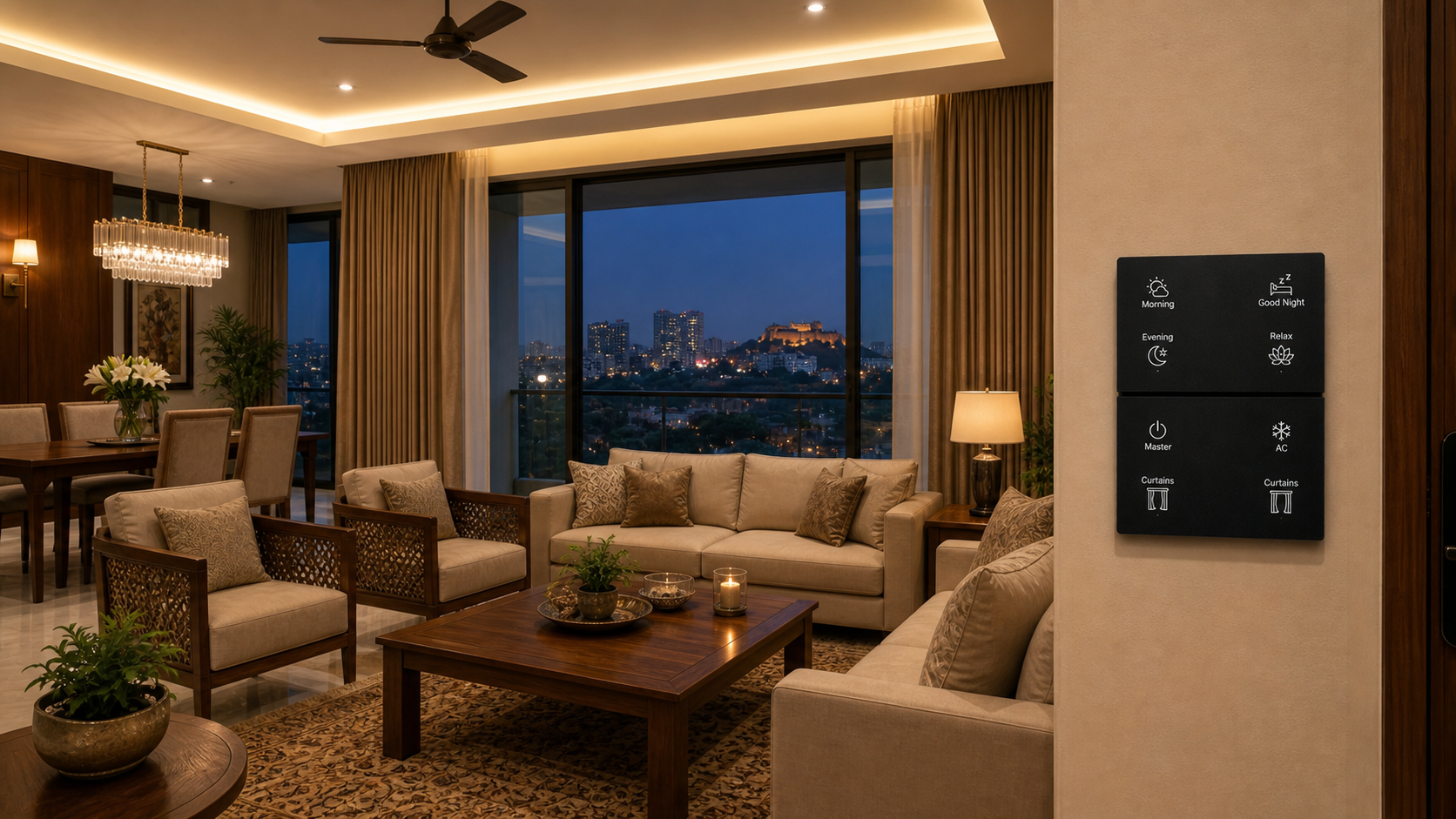
When people search for wireless home automation, they are often trying to answer a few practical questions: will it be reliable, does it depend on Wi-Fi, is it easier to install, and will it still feel premium in a larger home? Those are the right questions.
If you want the broader smart-home foundation first, start with the main home automation guide. If you want the comparison view, read Wired vs Wireless Home Automation. This article stays focused on wireless automation itself.
What wireless home automation actually means
Wireless home automation means the control devices and smart components communicate without dedicated control wiring running between every switch and load point. That does not automatically mean internet-dependent control, and it does not automatically mean low reliability. The quality depends on the protocol, system design, scene logic, and the control layer.
Wireless automation is not the same as Wi-Fi gadgets
One of the biggest misconceptions in the market is assuming wireless automation simply means adding many Wi-Fi devices and controlling them from separate apps. That is not the right benchmark for a serious home-automation project.
A properly designed wireless system should behave like a coordinated smart home, not a collection of disconnected gadgets.
Why homeowners choose wireless automation
Wireless automation has become more attractive because it solves several practical problems cleanly:
- less wiring disruption
- easier expansion later
- faster execution in many projects
- strong fit for renovation and phased automation
- simpler long-term maintenance when planned well
For homes where the owner wants scene control, lighting ambience, curtain automation, comfort integration, and better daily usability without overbuilding infrastructure, wireless automation is often the better fit.
Where wireless automation works especially well
Wireless automation can work well in:
- new homes that want cleaner planning without heavy control infrastructure
- apartments where simplicity matters
- renovation projects where rewiring should be minimized
- villas that need flexibility, scenes, and maintainability
Read Home Automation for Villas vs Apartments and Can You Add Home Automation During Renovation in Hyderabad?.
Why scene control matters more than the wireless label
Wireless automation becomes valuable when it is scene-led. If it only gives app control for individual devices, the system stays fragmented. What makes it useful is the ability to create practical scenes for:
- Morning
- Evening
- Relax
- Night
- All Off
That is where good keypads and lighting design matter. Read Why Scene-Based Automation Is Better Than App-Only Smart Devices.
Is wireless automation reliable enough?
Yes, if the system is designed properly. Reliability is not only about the communication method. It is about the overall architecture, the control strategy, and how recoverable the home feels in daily use.
Ask practical questions:
- Does the home still feel easy to use if internet is down?
- Are the main scenes available from the wall?
- Is the control logic simple enough to maintain?
Read Do Smart Homes Work During Power Cuts and Internet Outages? and Is Home Automation Reliable in India?.
Wireless automation still needs good planning
Wireless does not mean you can ignore planning. The right scene points, lighting zones, curtain provisions, and keypad locations still matter. If those are weak, the system will feel weaker no matter how easy it was to install.
Read How to Plan Smart Lighting for a New Home and How to Plan Keypads in a Home.
Why wireless automation is often easier to maintain
In many homes, the best long-term system is not the one with the most infrastructure. It is the one that remains understandable, practical, and serviceable after handover. Wireless automation often works well here because expansion and adjustment can be cleaner when the original planning is good.
Final thoughts
Wireless home automation is a strong option because it combines practicality with real lifestyle benefits. It can deliver scene control, smart lighting, curtain integration, comfort, and better daily usability without forcing unnecessary complexity into the home. The real decision is not wired versus wireless in the abstract. It is whether the system gives you the control, ambience, maintenance comfort, and daily simplicity the home actually needs.
For product direction, explore Smart Keypads and Smart Lighting. For a project discussion, contact Pert.