
That is why it is important to understand the difference between wired and wireless home automation in practical terms, not just technical terms. For many homes being built today, especially larger villas and 4-5 BHK residences, a well-designed Zigbee-based wireless system can deliver the scenes, comfort, and convenience homeowners actually use every day, without unnecessary wiring changes or imported-system complexity.
Understanding wired vs wireless home automation
A wired home automation system usually depends on dedicated control wiring, centralized programming, and more complex infrastructure. In some cases, it also needs additional controllers, servers, or systems that must stay powered continuously. A wireless home automation system uses smart devices that communicate wirelessly. In our case, the system is based on Zigbee, not regular Wi-Fi, and that distinction is important.
Myth 1: Wireless automation means Wi-Fi automation
This is one of the biggest myths in the market. Our automation solution is wireless, but it is not dependent on the Wi-Fi router for core operation. The devices communicate over Zigbee through a gateway. That includes the Stella keypad, Zigbee smart drivers for lights, Zigbee curtain motors, and Zigbee IR blasters for AC control. If internet is available, customers also get remote control and voice control. But the day-to-day automation logic is not dependent on the internet for basic scene execution.
Myth 2: Wired automation is always better
Wired systems are often positioned as premium solutions, but better does not always mean more suitable. For a homeowner building a practical luxury home, the more important questions are: is the system easy to use, can it create the scenes I need, is it easy to maintain after handover, and will service be simple in the long run? A system can be technically advanced and still be unnecessarily complicated for the user.
How our wireless automation solution works
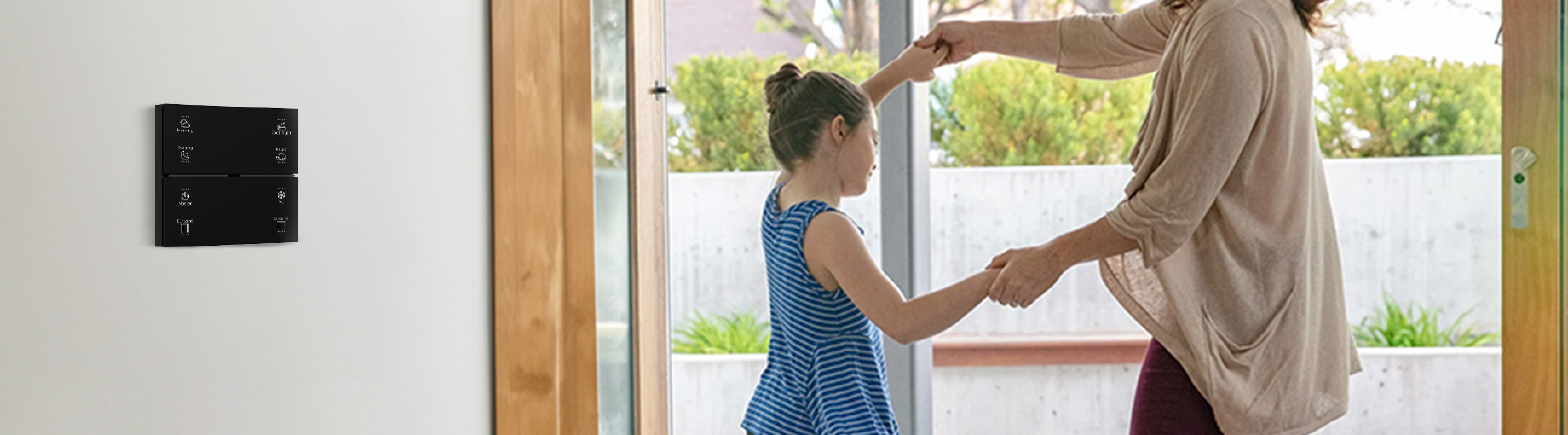
Our approach is scene-first. In each area, we typically provide a Stella keypad, which fits into a standard 2-module box. Stella has 8 buttons and can be configured as 8 scene buttons or 4 scene buttons and 4 relay controls. This makes it practical for daily living because the customer can trigger actions instantly from the wall without opening an app.
Along with Stella, we use Zigbee smart drivers for lights, Zigbee curtain motors, and Zigbee IR blasters for AC control. Instead of focusing only on device-level control, we create scenes that match the way people live.
Typical scenes we create
- Master: all lights on/off
- AC: on/off via IR blaster
- Main Curtain: open/close
- Sheer Curtain: open/close
- Morning Scene
- Evening Scene
- Relax Scene
- Night Scene
This is what makes automation feel useful. The customer is not controlling random devices one by one. They are controlling the experience of the room.
Typical room-by-room planning
In bedrooms, we usually provide two keypads, one at the entrance and one at the bedside. This allows convenient control while entering the room and while getting ready to sleep. In bathrooms, we usually provide a microwave sensor for lights and exhaust fan, along with a smart plug for geyser control. In living, dining, drawing, and kitchen spaces, we usually provide one Stella keypad in each area, one IR blaster where AC integration is needed, and smart curtains in common areas where required.
No wiring changes required
One of the biggest practical advantages of our wireless solution is this: we do not need to change a single wire. The lights communicate wirelessly with the keypad through Zigbee smart drivers and the gateway. Driver installation is handled by the electrician, and our engineers visit the site to install the keypads and program the scenes on the app. For a 4-5 BHK house, this process typically takes around 2 days.
Scenes, schedules, and circadian rhythm based lighting
A home should not just be controllable. It should respond intelligently to the way people live. That is why our system supports scenes, schedules, circadian rhythm based lighting, and gradual dimming or brightness changes. For example, we can create a feature where brightness slowly increases from 0 to 100 over 15 minutes. This is useful for morning routines and creates a far better lighting experience than a sudden switch-on.
Customers who want to explore the lighting side of this setup can review our smart lighting products, which are designed for scene-based automation and integrated control.
Easy maintenance and practical after-sales support
When comparing wired vs wireless automation, installation is only one part of the decision. Long-term service matters just as much. Our system is designed to be easy to install, easy to maintain, easy to expand, and easy to support after handover. The products are made in India, manufactured in-house, and designed for Indian environments. That gives customers stronger practical advantages in serviceability, availability, affordability, and long-term support.
How this compares to wired or DALI-style systems
Wired systems, including DALI-style solutions, may be suitable in certain projects. But homeowners should understand the tradeoffs clearly. Compared to a Zigbee-based wireless automation setup, wired systems often involve wiring changes, more complex design planning, more complicated programming, server or controller dependencies, full system inverter backup requirements, longer product lead times, imported hardware, and more specialized after-sales maintenance.
In many cases, products for such systems can take 3 to 4 months to arrive. Programming can be more involved. Service often requires specialized engineers. That does not mean wired systems are wrong. It means they are not automatically the best answer for every home.
So what should a homeowner choose?
If you are building a house, the best decision is usually the one that gives you practical control, reliable scene automation, easy maintenance, faster installation, simpler service, lower complexity, and products designed for local conditions. For many homes, especially villas and larger residences, a Zigbee-based wireless automation system can deliver the smart lighting, curtain control, AC integration, scene control, schedules, remote access, and voice control most customers actually want without forcing the homeowner into a highly complicated infrastructure.
Why Stella keypads make the difference
A major reason this system works well is the Stella keypad. Because Stella can be programmed for scenes and relay controls, it becomes the everyday interface for the customer. Instead of navigating apps every time, customers use one-touch controls at the wall to activate the exact combination they need. That is what makes the home feel smart in real life.
Explore the products behind this setup
To understand this setup further, explore: Smart Keypads, Stella Keypads, Smart Lighting, Curtain Automation, Pert Catalogue, and Contact Pert.
FAQ
Is wireless home automation dependent on Wi-Fi?
No. Our wireless automation solution works on Zigbee through a gateway. Core control is not dependent on the internet router.
Do I need to change wiring for this system?
No. We do not need to change a single wire for the typical setup described here.
What is the benefit of Stella keypads?
The Stella keypad gives practical scene-based control in each area. It fits in a standard 2-module box and can be configured as 8 scenes or 4 scenes plus 4 relays.
Can this system control lights, curtains, and AC together?
Yes. That is one of the main advantages. We combine smart lights, Zigbee curtain motors, and Zigbee IR blasters into practical scenes.
What do you usually install in bedrooms?
Usually one Stella keypad at the entrance and one at the bedside, so the room can be controlled easily from both positions.
What do you install in bathrooms?
We typically use a microwave sensor for lights and exhaust fan, along with a smart plug for the geyser.
How long does installation take for a large house?
For a 4-5 BHK house, keypad installation and scene programming typically takes around 2 days after the electrician completes the driver installation.
Is wireless automation easy to maintain?
Yes. It is much easier to maintain than many complex imported systems. The products are made in India, manufactured in-house, and designed for Indian conditions.