
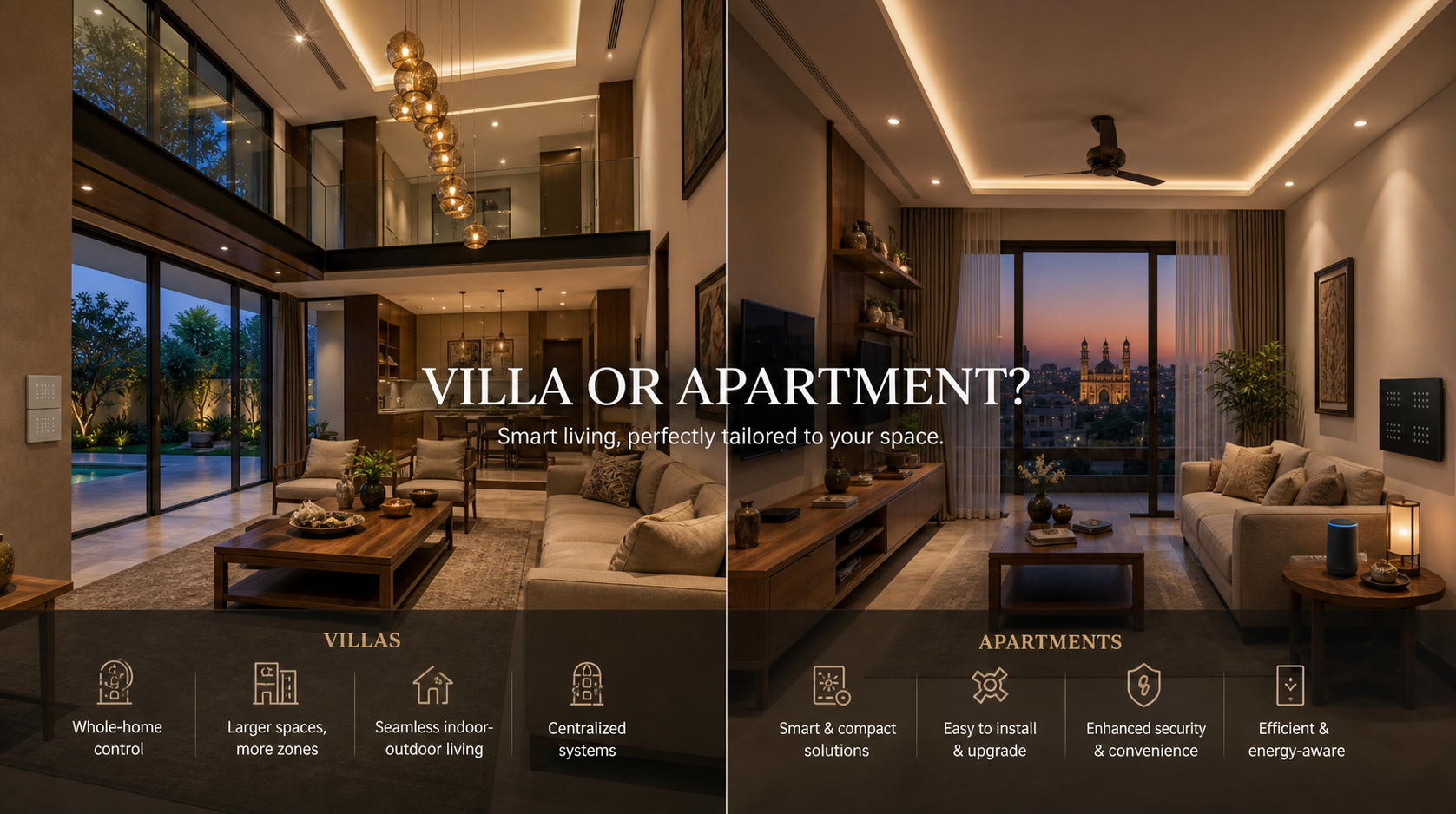
People often ask whether the same home automation setup can work across all project types. It can in a basic sense, but that is not the right way to evaluate it. A villa usually needs wider scene planning, stronger access logic, and more layered control. An apartment usually needs tighter prioritization and cleaner room-by-room decisions.
If you want the broadest overview first, begin with the main home automation guide. If you are deciding between a villa-style and apartment-style automation plan, these are the differences that matter.
What villas usually need more of
Villas tend to have more space, more transitions, and more zones that need to feel coordinated. That changes automation planning immediately.
- More scene relationships across living, dining, family, and outdoor-adjacent areas
- Broader security and access planning
- More entrance and circulation-based keypad positions
- Greater need for curtain automation because of larger openings
- More attention to bedroom, guest-room, and staff-related control logic
What apartments usually need more of
Apartments usually benefit from disciplined prioritization. The goal is rarely to automate more. The goal is to automate the right things well.
- Strong lighting scenes in living and bedroom spaces
- Efficient keypad placement at entry, bedside, and main living points
- Curtain automation in the spaces where privacy and daylight matter most
- Comfort control that reduces remote clutter
- Minimal but effective scene planning instead of excessive layers
For apartment-specific thinking, read Best Home Automation Solutions for Apartments in Hyderabad.
Lighting planning changes with scale
Lighting matters in both home types, but the complexity differs. Villas often need more scene depth because spaces are larger and more open. Apartments usually need tighter zoning because every control must justify itself.
In villas, plan for:
- Longer transitions between public and private areas
- Multiple entertaining scenes
- Layered lighting across double-height or expansive living areas
In apartments, plan for:
- Compact scene sets that cover most routines well
- Fewer but better-zoned circuits
- Clean mood shifts between daytime, evening, and night use
Read How to Plan Smart Lighting for a New Home.
Keypad placement changes with circulation
Keypad strategy is one of the clearest differences between villas and apartments. Villas need more control points because people move through more spaces and entrances. Apartments usually need fewer, but those few positions need to be exact.
Villas often need:
- Main entry scene control
- Secondary circulation points near stairs or family areas
- Living and dining scene control
- Bedside keypads in key bedrooms
Apartments often need:
- Main entry control
- Living room scene keypad
- Bedside keypads where comfort is a priority
See How to Plan Keypads in a Home and explore smart keypads.
Curtains are often more strategic in villas
Most villas have larger openings, taller glazing, and more spaces where daylight and privacy change throughout the day. That makes curtain automation more than a convenience feature. It becomes part of how the home performs.
Apartments also benefit from smart curtains, but usually in more targeted areas such as living rooms and main bedrooms. Villas often need a broader curtain plan integrated into multiple scenes.
Security planning differs materially
Apartments and villas do not carry the same access-control problem. Villas usually need more deliberate planning around entry points, staff movement, gates, outdoor areas, and perimeter-aware thinking. Apartments often focus on the main door, internal convenience, and selected monitoring layers.
This does not mean every villa needs a larger device list. It means the logic around entry, exit, and occupancy changes more.
Renovation and new construction behave differently
Within both categories, project stage matters. A villa under new construction can support deeper provisions for lighting, curtains, sensors, and access points. An apartment under renovation may benefit more from a practical hybrid strategy.
Read Can You Add Home Automation During Renovation in Hyderabad? and When Should You Plan Home Automation During Construction?.
Which property type needs more planning effort?
Villas usually need more overall planning effort because there are more transitions, more zones, and more opportunities for inconsistency if the control logic is weak. Apartments usually need more ruthless prioritization because every circuit, keypad, and scene must deliver visible daily value.
What should stay the same in both?
Regardless of property type, the fundamentals do not change:
- Plan around scenes, not disconnected gadgets
- Do not depend on app control alone
- Use lighting, curtains, and comfort as one coordinated layer where possible
- Keep the architecture maintainable
- Choose a system with solid after-sales support
If reliability is the concern, read Is Home Automation Reliable in India?.
Final thoughts
Home automation for villas and apartments should not be treated as the same design problem. Villas need broader planning and stronger circulation logic. Apartments need tighter prioritization and cleaner execution. In both cases, the best result comes from understanding how the home is actually lived in, then choosing the right scene, lighting, curtain, and control strategy for that layout.
For property-specific help, see Best Home Automation in Hyderabad for Villas and Best Home Automation Solutions for Apartments in Hyderabad.