
In this guide
- Why festivals break everyday automation
- Hosting scenes, without reprogramming your keypads
- Temporary schedules for festive and balcony lighting
- Sensors, curtains and diyas with a full house
- Guests, vendors, door access and quieter alerts
- When the family travels home for the festival
- A worked example: Diwali evening in a 3BHK
- The after-festival reset checklist
- How Pert delivers it (designed, not DIY)
- FAQs
This article is part of our wider coverage of home automation in Hyderabad. It builds on two earlier guides: how home automation modes work, which explains Home, Away, Night and Guest modes, and how to schedule home automation, which covers sunset triggers and date-bounded schedules. Here we apply both to the busiest weeks of the year.
Why festivals break everyday automation
Automations are built on assumptions about how a household lives. Festivals change almost every one of those assumptions at once, for a few days, and then change them back.
| Everyday assumption | What changes during a festival or party | What goes wrong if nothing is adjusted |
|---|---|---|
| A few people, in predictable rooms | Guests in every room, including rooms normally empty in the evening | Vacancy timers switch lights off on seated guests; guest room follows the family's schedules |
| Bedtime around 10:30–11 pm | Dinner and card games past midnight | An 11 pm house-wide dim or Good Night drops the living room into darkness mid-conversation |
| Only the designed lighting loads | Serial lights, lanterns and decorative strings on balcony and facade sockets | Decorative lights are left on all night or forgotten entirely, because nothing controls them |
| Curtains can close freely at sunset | Diyas and candles on window sills, balcony ledges and in the puja room | A sunset rule closes fabric over a lit flame |
| The front door opens a few times a day | Relatives, caterers, decorators, deliveries and neighbours all evening | A notification for every opening; the owner mutes the app and misses the alert that matters |
| Somebody is usually home | The whole family travels to the hometown for several days | A dark, still flat in a community where every other home is lit |
The goal is not to rebuild the automation for a week. It is to have a small number of switches, usually a mode and a handful of temporary rules, that change the behaviour cleanly and undo themselves afterwards.
Hosting scenes, without reprogramming your keypads
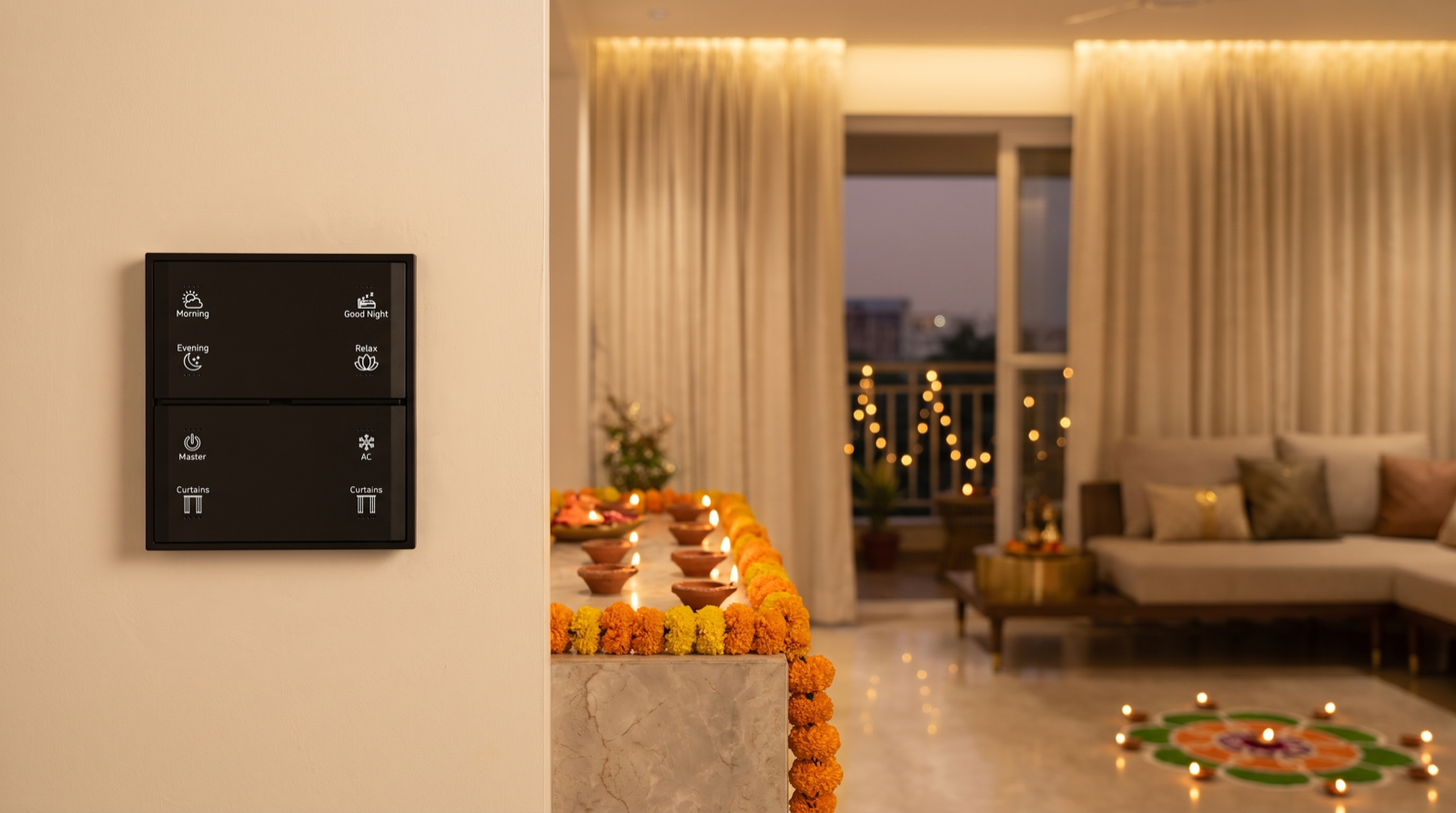
The first instinct is often to change what the wall buttons do. Resist it. A Stella keypad carries engraved labels such as Evening, Relax and Good Night, and every family member presses them from habit. If Relax means something different for one week, the grandparents staying over will not know, and after the festival nobody remembers to change it back.
There are two cleaner ways to get festival behaviour:
- Temporary hosting scenes in the app. Add two to four scenes for the occasion and use them from a phone or a voice assistant. They do not touch the keypads and can be deleted afterwards.
- A Festival or Guest mode that adjusts existing scenes. While the mode is on, Evening also switches on the balcony circuit, and Good Night leaves the guest room and the living room alone. The buttons keep their meaning; the mode changes the details. How modes reshape scenes and schedules is covered in how home automation modes work.
Most homes need only a few hosting scenes. A typical set:
| Scene | Lighting | Curtains | Other |
|---|---|---|---|
| Guests Arriving | Foyer, living and dining at full; warm colour temperature; balcony and facade on | Living room curtains open (if no lamps on the sill) | Entrance and corridor lights held on, not on motion timers |
| Puja | Puja room at full; adjacent living lights dimmed to around 30–40% so the lamps read | No automatic movement in the puja room | Notifications quietened for the duration |
| Dinner | Dining at a comfortable level, living area lowered, kitchen task lights on | Unchanged | AC to a set temperature if the room is full |
| Wind-down | Living at a low warm level, path lights on, decorative and accent off | Close, but only those not near lamps | Balcony stays on until its scheduled off time |
Every scene sets definite levels rather than toggling, so pressing it twice does not reverse it. For how to build scenes that behave predictably, see how to design home automation scenes.
Temporary schedules for festive and balcony lighting
Festive lighting is where automation earns its keep. Without it, serial lights get switched on late on the first evening, left on until 3 am on the second, and forgotten on the third. With it, they come on at dusk and go off at a fixed hour, every night of the festival, and then stop.
Give the decorative lights a circuit the system can switch
Decorative strings plug into sockets, and an ordinary socket is not something the automation can control. The fix is planned at design stage: one balcony or facade socket circuit is wired to an automation channel, so whatever is plugged in there, serial lights, lanterns, a festive string on the facade, can be scheduled. If this was not planned, it can often be added during a retrofit. Two cautions apply. The decorative load must sit comfortably within the rating of that channel, and outdoor and balcony sockets must be properly protected against moisture and earth leakage. Both are covered in electrical safety and power protection for a smart home.
Use date-bounded schedules with an end date
The single most useful feature for festivals is a schedule that is active only between two dates. Set it once and it switches itself off when the festival ends, with nothing to remember.
| Schedule | Trigger | Active dates | Note |
|---|---|---|---|
| Balcony and facade festive lights on | Sunset, or 10–15 minutes after | From Dhanteras to the day after Diwali | Sunset tracks the actual dusk time, which in Hyderabad shifts noticeably through October and November |
| Festive lights off | Fixed time, for example 11:30 pm | Same dates | A later off time on the main festival night can be a one-day exception |
| Entrance light held on | Sunset to 11:30 pm | Same dates | Replaces the usual motion-timed entrance light while visitors are expected |
| Morning curtains later | Shifted 60–90 minutes | Festival days only | Late nights mean nobody wants curtains opening at 6:45 am |
The same pattern covers other occasions: a wedding week, Christmas lights in December, a long weekend house party. Sunset triggers, time windows and calendar-bounded rules are explained in how to schedule home automation.
Sensors, curtains and diyas with a full house
Motion and occupancy timeouts
Vacancy timers are tuned for the family's normal movement. A 2-minute timeout in the guest powder room, or a 5-minute timeout in a living area with a sensor, works fine on a quiet Tuesday and switches lights off on seated guests during a party. For the festival, either extend the timeouts in rooms guests use, or have the hosting scenes hold those lights on until Wind-down. Corridor and staircase path lighting that comes on at a low night level should stay armed, because guests sleeping over do not know where the switches are. Timeouts and re-triggering are covered in sensor-triggered home automation.
Night rules and the guest room
A house-wide Good Night at 11 pm that turns off every light is a problem when relatives are still talking in the living room or already asleep in the guest room. Guest mode should take the guest bedroom out of every family schedule, so its lights and curtains do only what the person inside asks, and Good Night from the master bedroom should not reach the living room while hosting.
Curtains and lit flames: pause automatic closing
This is the safety point most homes miss. Diyas are placed on window sills, balcony ledges and in the puja room, often right where a curtain falls. A sunset rule, an Evening scene or a Good Night that closes motorised curtains will draw fabric across those spots with nobody watching. During the festival:
- Pause automatic closing for the puja room curtain and for any window or balcony door where lamps are placed.
- Remove those curtains from scenes that close "all curtains" for the festival days.
- Leave manual control at the keypad, so a person who can see the window decides when to close it.
- Put re-enabling these rules on the after-festival checklist, so normal privacy and heat control return.
How curtain positions, limits and scene membership work is explained in how motorised curtain automation works.
Guests, vendors, door access and quieter alerts
Temporary access that expires
Festival weeks bring people who need to get in without the owner: relatives arriving on an early train, a caterer setting up, a decorator on the balcony, extra domestic help. If your smart door lock supports temporary or time-limited codes, issue one per person with an end date, rather than sharing the family code. Codes that expire need no cleanup; a shared family code needs changing afterwards, which rarely happens. Roles, temporary access and what each person should be able to control are covered in how to manage smart home access for family, staff and guests.
Alerts that stay useful
A door-open notification for every arrival on Diwali evening trains everyone to ignore the app. Instead of muting everything, quieten only the high-traffic events while hosting: front-door opening alerts become a summary or are suppressed while the house is in Guest or Festival mode and someone is home. Keep the alerts that matter at any time: a door left open late at night, the lock failing to engage, a power interruption, a camera event after everyone has gone to bed. How to decide which alerts deserve a notification is in how to design smart home notifications and alerts.
Make the keypads readable for visitors
Guests will use the wall keypads, not the app. Clearly engraved, backlit labels mean a visiting aunt can press Good Night in the guest room without a tutorial. This is one more reason not to repurpose buttons for the week.
When the family travels home for the festival
Hyderabad empties out at Sankranti, and many families travel for Diwali and Dussehra too. A flat with a dark balcony on Diwali night, in a tower where every other balcony is lit, is an obvious empty home. Away mode should take the festival into account:
- Festive balcony lights still run on their schedule, sunset to a normal off time, so the home looks like its neighbours.
- Presence simulation in living areas varies lights through the evening rather than switching the same light at the same minute.
- Curtains sit in a believable position, partly closed, rather than fully open or fully shut for five days.
- Alerts for door, lock and power events stay on, so you know if the power went out on day two and whether the gateway and cameras came back.
Before leaving, switch off lamps and remove any temporary decorative loads you do not want running unattended. A full guide to away mode is in how to plan away mode for a smart home when you travel.
A worked example: Diwali evening in a 3BHK
A 3BHK in a Hyderabad gated community, Pert keypads in every room, tunable lighting in the living and dining areas, motorised curtains in the living room and master bedroom, a balcony socket circuit on an automation channel. Parents and two grandparents are staying for the festival; around twenty guests are expected for dinner. Festival mode is on for five days.
| Time | Event | What the home does |
|---|---|---|
| Dusk | Sunset schedule (festival dates only) | Balcony serial lights and the entrance light switch on. Living room curtains do not close automatically, because diyas are on the sill |
| 6:45 pm | Host taps Puja in the app | Puja room at full, living area lowered so the lamps read, notifications quietened |
| 7:30 pm | Guests Arriving | Foyer, living and dining up; corridor and powder room held on instead of running on short motion timers. Front-door opening alerts suppressed while hosting |
| 9:00 pm | Dinner | Dining at a comfortable level, kitchen task lights on, living area slightly lower; AC set to a fixed temperature |
| 10:30 pm | Grandparents press Good Night in the guest room | Only the guest room responds; the living room and its guests are unaffected |
| 11:30 pm | Festive lights off schedule | Balcony circuit switches off. The party carries on in the living room |
| 12:45 am | Last guests leave; host presses Wind-down, then Master | Path lights on, everything else off. The lock engages; an alert would fire if it did not. Hosts close the living curtains by hand once the diyas are out |
Five days later the festival dates end, the balcony schedule stops on its own, and the household switches Festival mode off. The keypads never changed.
The after-festival reset checklist
Most festival problems are not during the festival but in the weeks after, when temporary changes are still quietly active. Ten minutes with this list puts the home back:
- Switch off Festival or Guest mode, so schedules, Good Night and alerts return to normal.
- Check that date-bounded schedules have ended, and delete any one-off schedules created without an end date.
- Re-enable automatic curtain closing in the puja room and on windows where lamps were placed, once the lamps are cleared.
- Restore motion timeouts in rooms where they were extended.
- Revoke or confirm expiry of temporary door codes for relatives, caterers and decorators.
- Unplug decorative strings from the automated socket circuit, or the next sunset schedule may find them still there.
- Delete or keep hosting scenes; many families keep them for the next party.
- Turn front-door alerts back on if they were suppressed rather than tied to the mode.
If something still behaves strangely afterwards, it is almost always a leftover temporary rule. How home automation resolves conflicts, overrides and timers explains how to find which rule is acting.
How Pert delivers it — a designed solution, not a DIY kit
Pert designs and installs the whole system: keypads, tunable and dimmable lighting, motorised curtains and security devices, working together over Zigbee through the Pert gateway. Festivals are part of that design, not a scramble the week before. During design we ask how your household celebrates: whether you host large gatherings or travel home, where diyas and decorative lights go, and which balcony or facade sockets should be on an automation channel. We then set up the modes and the hosting scenes as part of commissioning, so that before a festival you switch on one mode and add the dates, rather than rebuilding your automation. If you want help setting up a specific occasion, a wedding week or a big Diwali gathering, our support team can adjust the scenes and schedules with you and set them to expire afterwards.
Planning home automation for a Hyderabad flat or villa? We will design the keypads, scenes, lighting, curtains and security as one system, including how it behaves when the house is full of guests or empty for the festival. Request a consultation →
Comparing installers? Ask each one how you would add a festive lighting schedule, whether a balcony socket can be put on automation, and how guest access and alerts work when the house is full. Those questions sit alongside the wider checklist in best home automation companies in Hyderabad.
Frequently asked questions
Should I reprogram my keypad buttons for Diwali or a party?
Usually not. Keypad buttons carry engraved labels, and family members press them from habit, so changing what Relax or Evening does for one week causes more confusion than it saves. A better approach is to add one or two temporary hosting scenes in the app, or to let a house mode such as Guest or Festival adjust what the existing scenes do, and then switch that mode off after the festival. The buttons keep their meaning and the festive behaviour disappears on its own.
How do I make festive lights come on automatically every evening during Diwali?
Put the decorative lighting on a circuit the automation system can switch, usually a balcony or facade socket circuit that was planned as an automation channel, and create a date-bounded schedule: on at sunset, off at a fixed time such as 11 pm, active only between two dates. Because the schedule has an end date, it stops by itself after the festival. Serial lights and decorative strings should be within the rated load of that channel, and outdoor sockets should be properly protected.
Can automatic curtains be a fire risk near diyas and candles?
Yes, if a schedule or sunset rule closes a curtain over a window sill or ledge where diyas or candles are lit. During festivals, automatic closing should be paused for curtains in the puja room and on windows or balcony doors where lamps are placed, and curtains in those spots should be closed only by a person who can see the window. This is a temporary rule change that is easy to set up and easy to forget, so it belongs on the festival checklist.
What should my smart home do while we travel home for Sankranti or Diwali?
Use away mode with a festive adjustment. Many Hyderabad families travel to their hometowns for Sankranti or Diwali, and an apartment with a dark balcony while every neighbour's balcony is lit stands out. Away mode can run presence simulation in the living areas, switch the balcony or facade lights on at sunset and off at a normal hour, keep curtains in a believable position, and send alerts for door, lock and power events. Everything returns to normal when you switch back to Home mode.