
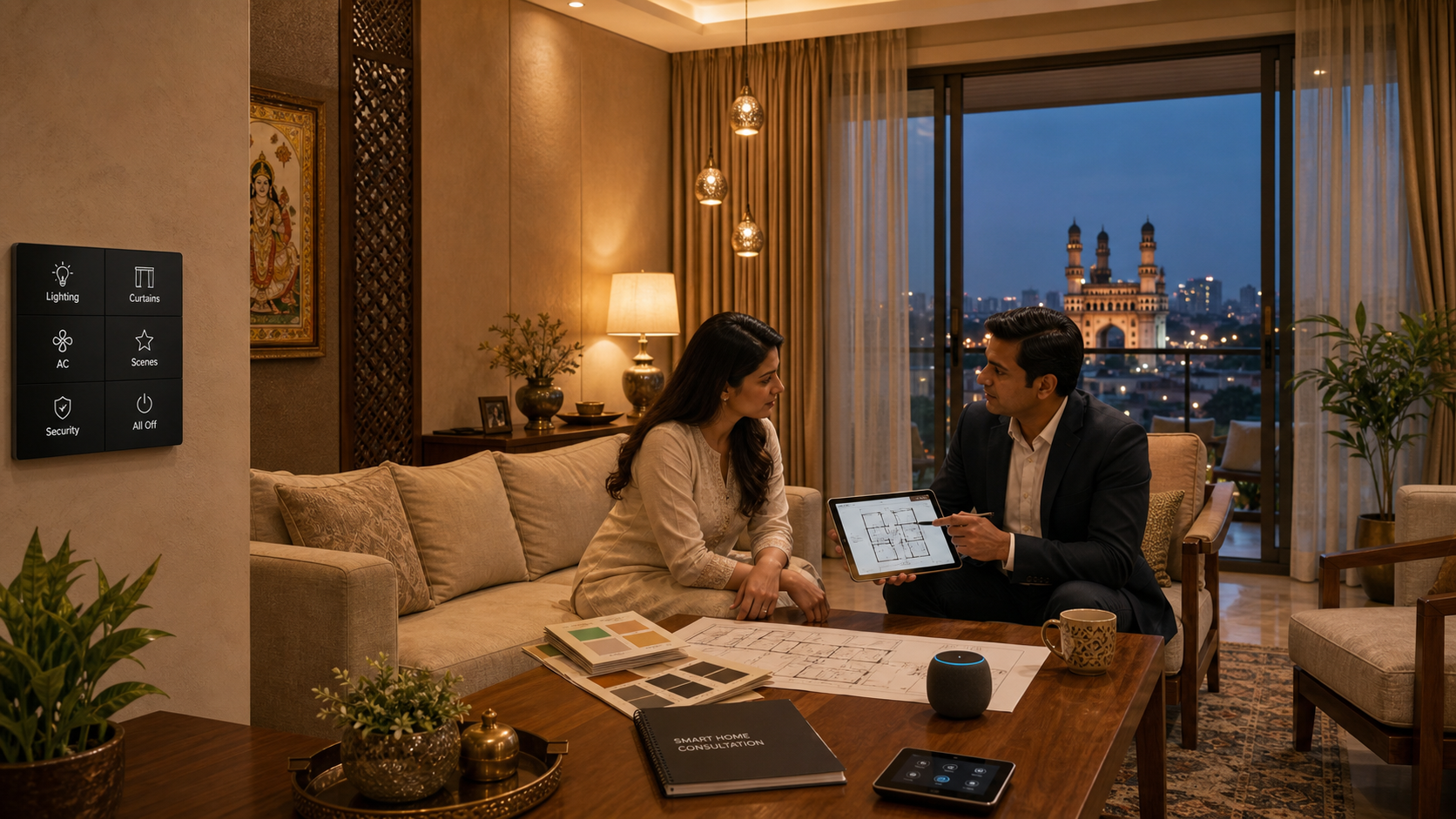
Many homeowners exploring home automation ask for a consultation after they have seen products online or visited a showroom. That is fine, but the real value of a consultation is not product display. It is decision quality.
A good consultation should reduce ambiguity around layout, scenes, controls, timing, and priorities. If you want the broad system overview first, start with the main home automation guide.
Start with how the home is actually used
The first part of a useful consultation should focus on routines, not devices. The consultant should understand:
- How the family enters and exits the home
- Which rooms are used most heavily
- How mornings, evenings, entertaining, and bedtime typically work
- Which spaces need privacy, comfort, or stronger control logic
Without this, the project quickly becomes a feature list rather than a living system.
Room-by-room automation scope should be discussed
A proper consultation should go room by room and identify what belongs where. That usually includes:
- Lighting scene opportunities
- Curtain automation needs
- Comfort or AC integration priorities
- Keypad placement opportunities
- Security or sensor needs in specific zones
See Best Home Automation Ideas for Bedrooms, Living Rooms, and Dining Areas.
Lighting and scene planning should be central
If a consultation does not go deep enough on lighting and scenes, it is incomplete. The consultant should be able to explain:
- Which lighting layers matter in each room
- Which scenes should exist
- Where dimming or zoned control is worth planning
- How lighting works with curtains and comfort
Read How to Plan Smart Lighting for a New Home.
Keypad and control strategy should be explicit
A strong consultation should not assume app control is enough. It should identify the real daily control points in the home:
- Main entry keypad
- Living room scene control
- Bedside keypads
- Exit or all-off positions
This is one of the most important parts of usability. Read How to Plan Keypads in a Home.
Planning stage and rework risk should be clarified
The consultation should also establish where the project is in its lifecycle. A new home in design stage, an active construction site, and a renovation project each need different decisions.
The consultant should clearly explain:
- What can still be planned cleanly
- What needs provision now to avoid rework later
- Whether the project is better suited to a deeper or lighter automation scope
Relevant reads: construction planning and renovation planning.
Property type should change the conversation
A villa and an apartment should not receive the same planning conversation. A good consultation should adapt scope based on project type, including circulation, security, lighting scale, and curtain planning.
Read Home Automation for Villas vs Apartments: What Changes in Planning?.
Reliability and maintenance should be addressed early
Consultations often stay focused on features and visuals. That is not enough. Homeowners should also understand:
- How the system behaves during internet outages
- What happens after a power cut
- How easy it is to maintain or adjust later
- Whether the architecture is practical or overly complex
Read Do Smart Homes Work During Power Cuts and Internet Outages?.
Budget framing should be practical, not vague
A useful consultation should help the homeowner understand scope and budgeting in realistic terms. It does not have to turn into a final quotation immediately, but it should clarify what cost drivers matter:
- How many spaces are being automated
- How deep the lighting and keypad strategy goes
- Whether curtains, comfort, and security are included
- How much planning or rework is still required
Read Home Automation Cost in Hyderabad.
After-sales support should be part of the conversation
A smart home consultation should not stop at installation scope. It should also cover support expectations after handover:
- How scenes are adjusted later
- How service is handled if something changes
- Whether on-site support is available
- How future expansion is approached
This is one of the clearest ways to distinguish real project support from a simple product sale.
Final thoughts
A smart home consultation should help the homeowner make better design and planning decisions, not just choose devices. If the consultation covers room use, lighting scenes, keypads, curtains, comfort, timing, reliability, budgeting, and support, it is doing its job.
If you want to prepare before speaking to an integrator, use the main home automation guide. If you are ready to discuss a live project, contact Pert.