
In this guide
This article is part of our wider coverage of home automation in Hyderabad. It is about one specific problem of apartment living: being seen from the tower opposite.
How privacy through glass actually works
Whether someone outside can see in depends far more on light than on the glass. The rule is simple: you can see into whichever side is brighter.
| Time | Light outside vs inside | What the facing tower sees | What protects you |
|---|---|---|---|
| Daytime | Outside much brighter | Mostly reflections; little of your interior, especially behind a sheer | A sheer curtain is usually enough |
| Dusk | Roughly equal, then reversing | Your interior becomes visible as soon as your lights are brighter than the sky | The moment to close sheers, or more |
| Night, lights on | Inside far brighter | Your room clearly, even through a light sheer, which glows like a screen | A lined or blackout curtain; a sheer alone is not private |
| Night, lights off | Outside brighter | Very little | Nothing needed, but a TV or phone screen still shows |
Two practical conclusions follow. A sheer gives good privacy by day and poor privacy at night with lights on. And the change happens at dusk, which in Hyderabad moves between roughly 5:45 pm in late November and 7:00 pm in June, so a fixed clock time is always wrong for part of the year.
Which curtain layer does what
Most high-rise windows benefit from two motorised tracks: a sheer layer and a heavier layer. Our guide to choosing curtain fabrics for motorised curtains covers weights and linings in detail.
| Layer | Day privacy | Night privacy with lights on | Best use |
|---|---|---|---|
| Sheer or voile | Good | Poor: silhouettes and bright areas show | Daytime privacy while keeping daylight |
| Dim-out / lined fabric | Full | Good | Living rooms in the evening |
| Blackout | Full | Full | Bedrooms, dressing areas, media rooms |
| Partial positions (e.g. 30% open) | Depends on the angle to the facing tower | Partial | Keeping a strip of view on the side that is not overlooked |
Motorised curtains can stop at set positions, which matters here: often only part of a window wall faces the other tower directly. Our explainer on curtain limits, positions and scenes shows how those positions are set.
Five privacy automations that work
- Sunset sheer close. At sunset plus 10 minutes, close the sheers on overlooked windows. Because it follows the astronomical sunset, it moves with the seasons without anyone changing it. Our guide to sunrise and sunset routines explains offsets.
- Lights-on privacy. When the main lights in an overlooked room are turned on after sunset, close the heavier layer too. The trigger is your own lights, which is exactly when you become visible.
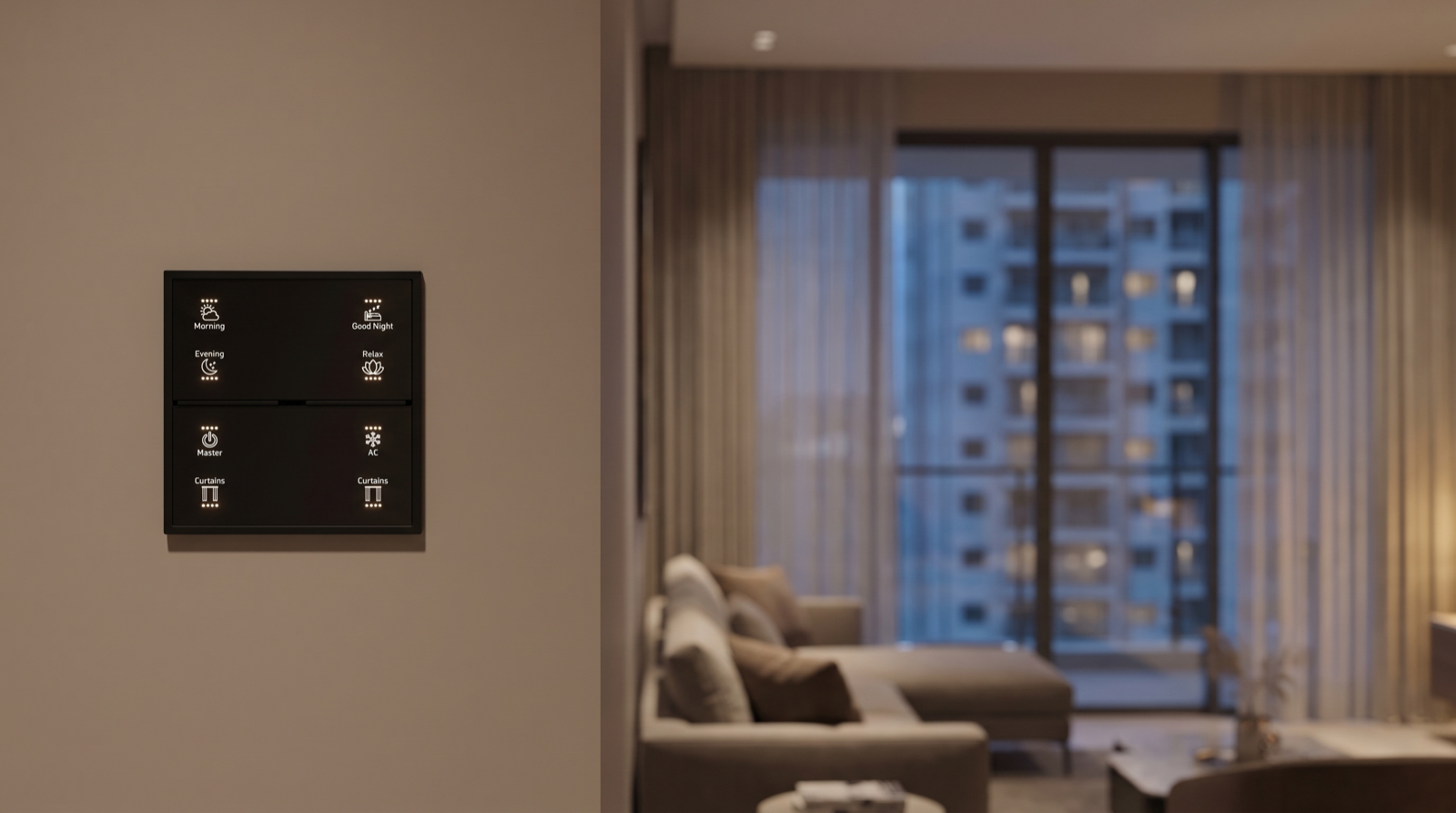
- Scene-linked privacy. Make Evening close the sheers and Relax close the lined layer, so everyday buttons handle privacy as a side effect.
- Bedroom and dressing privacy. When a bedroom light is turned on after dark, or the Good Night scene runs, close the blackout. In a dressing area, a wardrobe-door or motion trigger can close the curtain before lights reach full level.
- Morning release. On weekdays, open the heavy layer in shared rooms in the morning while leaving sheers closed until someone opens them, so you wake to daylight without putting the room on display.
Each rule should back off when someone overrides it at the keypad; the person standing at the window knows better than the schedule whether they want the view tonight.
Room-by-room privacy settings
| Room | Daytime | Evening | Night |
|---|---|---|---|
| Living room facing a tower | Sheer closed on overlooked panels; others open | Sheer closed at sunset; lined layer with Relax | Lined layer closed with Good Night |
| Dining | Open or sheer | Sheer closed at sunset | Lined closed |
| Master bedroom | Sheer closed | Blackout closes when lights come on after dark | Blackout closed |
| Kids’ room | Sheer closed | Blackout closes at bedtime scene | Blackout closed |
| Study or home office | Sheer for glare and privacy | Sheer closed; lined if on video calls with lights on | Closed |
| Balcony glass doors | As living room | Sheer closed at sunset | Closed |
Keeping daylight and the view
The opposite mistake is common too: families who are uncomfortable with the facing tower keep curtains closed all day and live under artificial light. Automation lets you avoid that:
- Close only the panels that face the tower; leave the ones with an open view.
- Use sheers by day; they cut the view in but keep daylight and some of the view out.
- On west-facing glass, combine privacy with afternoon heat control; our guide on planning lighting and curtains around daylight covers window orientation.
- Let the evening rule do the closing so nobody has to remember, and let anyone open a curtain with one press when they want the city lights.
Privacy from the inside: indoor cameras
Privacy is not only about the neighbours. If you have indoor cameras for when the home is empty, link them to the home’s mode: active in Away, and switched off or set to privacy mode in Home and Night. Keep cameras out of bedrooms and bathrooms altogether, point them at entrances rather than living spaces, and make sure only household members can see the feed. Our guide to managing access for family, staff and guests covers who should see what.
How Pert delivers it — a designed solution, not a DIY kit
Pert plans privacy as part of the design, not as an afterthought. We look at which windows face the next tower, specify sheer and heavier layers on separate tracks for motorised curtains, set intermediate positions where only part of a window is overlooked, and tie privacy to sunset, to your lighting and to the scenes on your Stella keypads. Security devices follow the home’s modes. It all runs on one Zigbee network through the Pert gateway, locally in the home, and our team installs and fine-tunes it after you move in. When you compare installers, our guide to the best home automation companies in Hyderabad lists what to ask.
Living in a high-rise with a tower across the way? We design and install lighting, curtains, keypads, scenes and security for apartments and villas across Hyderabad, and plan privacy window by window. Request a consultation →
Frequently asked questions
Can people see through sheer curtains at night?
Often, yes. Privacy through glass depends on which side is brighter. By day the outside is brighter, so a sheer gives good privacy. At night with your lights on, the inside is much brighter, and a light sheer glows like a screen that shows silhouettes and bright areas. For night privacy with lights on, close a lined or blackout layer.
What time should curtains close for privacy?
Not at a fixed clock time. You become visible when your lights are brighter than the sky, which happens around dusk, and in Hyderabad sunset moves by more than an hour across the year. Tie the privacy close to sunset with a small offset, and add a rule that closes the heavier layer when the main lights are turned on after dark.
Do I need two curtain layers for privacy in an apartment?
For rooms that face another tower, two motorised layers work best: a sheer for daytime privacy with daylight, and a lined or blackout layer for evenings and night. With separate tracks, automation can close the right layer at the right time instead of forcing a choice between no privacy and no daylight.
Can I close only part of a window wall?
Yes. Motorised curtains can be set to intermediate positions, so a scene or schedule can close only the panels that face the neighbouring tower and leave the rest open for the view. Where a window wall is split into separate curtains, each can have its own privacy rule.