
In this guide
- Why fabric is a motor decision, not just a décor one
- Weight: GSM, panel maths and motor rating
- Fullness and stack: how much wall you actually lose
- Sheer, dim-out and blackout: what each really does
- Pleat style and fold memory
- Clearances, pelmets and the double track
- Six fabric mistakes we fix on site
- Checklist for your furnishing vendor
- How Pert delivers it (designed, not DIY)
- FAQs
A manual curtain is forgiving. If it is heavy, you pull harder. If the hem drags, you tug it clear. A motorised curtain has no such judgement — it applies the same torque along the same path several thousand times a year, and anything the fabric does wrong, it does wrong every single time. That is why the fabric specification belongs in the automation conversation and not only in the soft-furnishing one. This article is part of our wider coverage of home automation in Hyderabad, and it sits directly alongside how to measure windows and choose tracks and motors — that guide covers the hardware, this one covers the cloth that hangs on it.
Why fabric is a motor decision, not just a décor one
Four properties of a fabric matter to a motor, and none of them are visible in a showroom swatch book.
- Mass. The motor has to accelerate the whole panel from standstill on every cycle. Starting torque, not running torque, is what fails first.
- Stiffness. A stiff, coated or rubber-backed cloth resists folding. It stacks wider, snags on itself and multiplies friction at the carriers.
- Fold memory. Fabrics that hold a trained pleat keep the wave even after a thousand cycles. Fabrics that do not turn into an untidy concertina within a season.
- Dimensional stability. Natural fibres move with humidity. In Hyderabad a pure linen drop can relax and grow one to two percent between a dry April and a wet August — on a 2.9m drop that is 30-58mm, which is the difference between a 12mm floor gap and a hem that drags.
Get those four right and almost any fabric can be motorised. Ignore them and even a good motor on a good track will disappoint. A broader look at the product categories and what each does well is in our guide to motorised curtains and smart blinds in Hyderabad.
Weight: GSM, panel maths and motor rating
Fabric weight is quoted in GSM — grams per square metre. These are the bands worth knowing:
- Sheers and voiles: 60-120 GSM. Light, high drape, negligible load. Usually the layer that runs most often because it is the daytime layer.
- Light decorative cottons and poly-blends: 150-220 GSM.
- Medium drapery — the workhorse band: 220-350 GSM. This is where most successful motorised curtains live.
- Heavy jacquards, wool blends and velvets: 400-600 GSM. Beautiful, and they double your load.
- Linings: 120-180 GSM for a plain lining, 150-250 GSM for a blackout lining. The lining is a second full-size panel and is routinely forgotten in the weight estimate.
The panel maths is simple enough to do in a showroom: track length × fullness × drop × (face GSM + lining GSM) ÷ 1000 = kilograms.
Two worked examples on the same 3m-wide, 2.9m-tall bedroom window at 2.2× fullness — 19.1 square metres of cloth either way:
- A 300 GSM cotton-blend face with a 150 GSM blackout lining: 19.1 × 450 = about 8.6kg. Comfortable on any standard track motor.
- A 550 GSM velvet with a 250 GSM blackout lining: 19.1 × 800 = about 15.3kg. Still workable, but it is nearly double the load, and it changes the track section, the carrier spacing and the motor you should be quoting.
Residential curtain track motors are typically rated 25-50kg. Design to 60-70% of the rated load, not to the rating itself. Headroom buys you quiet starts, gentle stops, cooler running and a gearbox that survives a decade of two cycles a day. It also absorbs the things nobody predicts — a heavier lining added later, a wider overlap, a fabric that gains weight when it is finally sent for a proper hem. And add the weights of both layers separately if you are running a sheer and a drape on a double track; they are two motors, two loads and two different answers.
Fullness and stack: how much wall you actually lose
Fullness is the ratio of fabric width to track length. It decides how the curtain looks closed and how much space it occupies open.
- Sheers: 2.5-3.0×. Sheers look thin and mean below 2.5× because you see through the gaps between folds.
- S-fold / ripplefold drapes: 2.0-2.4×, matched to the carrier spacing — 60mm, 80mm or 100mm carriers give progressively deeper waves. This is the cleanest look for a motorised curtain and the one we specify most.
- Pinch pleat: 2.0-2.5×. More traditional, slightly wider stack, and the heading itself adds bulk at the top.
- Eyelet headings: avoid on motorised tracks. Eyelets are a pole detail. They do not carry cleanly on a track and they do not stack predictably.
Then the part almost nobody budgets for. Stack-back is the width of the parked bundle of fabric:
- Light sheer: about 150-200mm of stack per metre of track.
- Medium S-fold at 2×: about 200-250mm per metre.
- Pinch pleat or heavy fabric: about 250-300mm per metre.
On a 3m centre-opening track with a medium S-fold, that is roughly 600-750mm of parked fabric, split into about 300-375mm at each end. If the track is exactly as wide as the window, that stack sits on the glass — you permanently lose about a third of a metre of view and daylight at each side, and the room is darker at 10am than it needs to be.
The fix costs nothing on a drawing and is impossible after tiling: extend the track 300-400mm past each side of the window opening onto solid wall so the curtain parks off the glass. Where only one side has spare wall, a one-way draw to that side beats a centre-open pair. Where the window runs wall to wall, the stack has to be absorbed inside the pocket, which is a pelmet dimension — see how to plan curtain pelmets and ceiling pockets.
Sheer, dim-out and blackout: what each really does
These three words are used loosely by furnishing vendors and precisely by nobody. The differences are measurable.
Sheer
An open-weave cloth with an openness factor of roughly 5-10%. It keeps daytime privacy from the outside while daylight is stronger outdoors than indoors, softens glare, and cuts a useful slice of solar heat. It does not give privacy after dark, when the lighting balance reverses and a lit room becomes a display case. Sheers are the layer that earns its keep in Hyderabad summers, and the shading economics are covered in smart curtains and energy savings.
Dim-out
A dense woven fabric, typically 250-400 GSM, that blocks roughly 85-95% of light. The room goes dark but the window remains a visible glow. Good for living rooms, media corners and guest bedrooms. It drapes far better than coated blackout and is often the right answer when the curtain is decorative first.
Blackout
Either a three-pass coated fabric (an acrylic foam layer sandwiched inside the cloth, blocking close to 99%) or a separate blackout lining behind a decorative face fabric. For motorised curtains we almost always specify the second. Coated blackout is stiff at 350-500 GSM, holds a soft fold badly, stacks wide and lumpy, and cannot be replaced independently when the face fabric is refreshed. A 200-300 GSM face with a 150-250 GSM blackout lining is darker in practice, drapes properly and folds with memory.
And a point worth repeating to every client planning a bedroom: blackout fabric alone does not make a dark room. Light leaks over the top, around the sides and through the centre gap. You need a closed pelmet or ceiling pocket, a 100-150mm return at each side where the curtain wraps back towards the wall, and a 50-100mm overlap at the centre where the two panels meet. Get those three and a dim-out fabric will out-perform a blackout fabric hung carelessly.
Pleat style and fold memory
Fold memory is the property that decides whether a motorised curtain still looks good in year three, and it is almost entirely a fibre question.
- Polyester and poly-blends hold a trained S-fold best. They are dimensionally stable, they take a heat-set pleat, and they recover their wave after every cycle. This is why so much good contemporary drapery is a poly-blend that reads as linen.
- Pure linen drapes beautifully and remembers nothing. It relaxes, it grows with humidity, and after a monsoon it hangs differently from how it hung in March. If a client wants real linen — and many do — we specify a slightly larger floor gap, a stable lining behind it, and set expectations that it will need re-dressing.
- Cotton sits between the two, and benefits most from a good lining, which does much of the structural work.
- Velvet has weight and pile direction. It stacks wide, it needs the pile running one way across the whole window, and it is the fabric most likely to push you into a larger motor.
Two construction details worth insisting on. First, a snap-hook or velcro heading that lets the panel be removed for dry cleaning without dismounting the track — otherwise every clean becomes a service call. Second, seam placement: fabric comes in standard widths, typically 140-150cm rolled vertically or 280-300cm railroaded. For drops under about 2.8m, a railroaded fabric avoids horizontal seams entirely; above that you will have vertical seams, and they should be placed to fall inside a fold rather than on the face of one.
Clearances, pelmets and the double track
These are the dimensions to put on the drawing before the ceiling closes.
- Hem to finished floor: 10-15mm. Never puddled. Measure from the finished floor after tile or wood is laid, and check at three points across the width — new floors are rarely level.
- Top of fabric to track: 15-25mm, so the heading clears the carriers without gapping light at the top.
- Side return: 100-150mm where the curtain wraps towards the wall. This is what kills the vertical light stripe at the edge.
- Centre overlap: 50-100mm on a centre-opening pair, with an overlap arm on the track so the two leading edges cross rather than meet.
- Double track spacing: 90-120mm centre to centre between the sheer track and the drape track, so the layers do not rub as they pass.
- Pelmet or ceiling pocket depth: 150-180mm for a single track, 200-250mm for a double, plus enough clear height to get a hand and a screwdriver in for servicing.
- Power: a 5A point inside the pocket at the motor end, not a wire hanging out of a false ceiling. Decide the motor end early, because it is fixed once the pocket is built.
Sequence matters as much as dimensions. The sheer belongs on the rear track, nearest the glass, and the heavier drape on the front track, room side. That way the daytime layer works without moving the night layer, and the drape reads as the decorative surface from inside the room.
Six fabric mistakes we fix on site
- The hem was made to touch the floor. The commonest of all. It looks luxurious in a photograph and it drags on every cycle, frays the leading edge and makes the motor read friction as an obstruction.
- Coated blackout chosen for an S-fold. The fabric will not hold a wave. Move the blackout to a separate lining and the same window looks like a different room.
- The track was made the width of the window. A third of a metre of glass permanently covered at each end, and no way to recover it without re-doing the pocket.
- Fullness cut to 1.8× to save fabric. The saving is a few thousand rupees; the result is a flat, mean-looking curtain on a system that cost far more than the cloth.
- The lining was never counted. Load estimated on the face fabric alone, so a 9kg curtain is quoted as a 6kg one and the motor is sized to the wrong number.
- Pure linen in a bedroom with a 10mm floor gap. Perfect in April, dragging by August. Either allow for the movement or choose a stable blend.
Every one of these is decided before a motor is switched on, and every one of them is cheap to avoid and expensive to correct. The wider case for treating curtains as a designed system rather than an accessory is in why smart curtains are useful for new age homes.
Checklist for your furnishing vendor
Print this and hand it over before the fabric is cut. It is ten lines and it prevents nearly every problem above.
- Face fabric GSM and lining GSM, both stated in writing.
- Calculated panel weight per side, with the lining included, checked against the motor rating at 60-70%.
- Fullness ratio confirmed — 2.0-2.4× for S-fold, 2.5-3.0× for sheers.
- Heading type: S-fold or pinch pleat, with carrier spacing to match. No eyelets on a track.
- Stack allowance calculated, and the track extended 300-400mm past each side of the opening.
- Hem 10-15mm above finished floor level, measured at three points.
- Side returns 100-150mm and a 50-100mm centre overlap for any bedroom.
- Blackout delivered as a separate lining, not a coated face fabric.
- Snap-hook or velcro heading so panels come off for cleaning without touching the track.
- Fibre content declared, with an allowance agreed for humidity movement if it is a natural fabric.
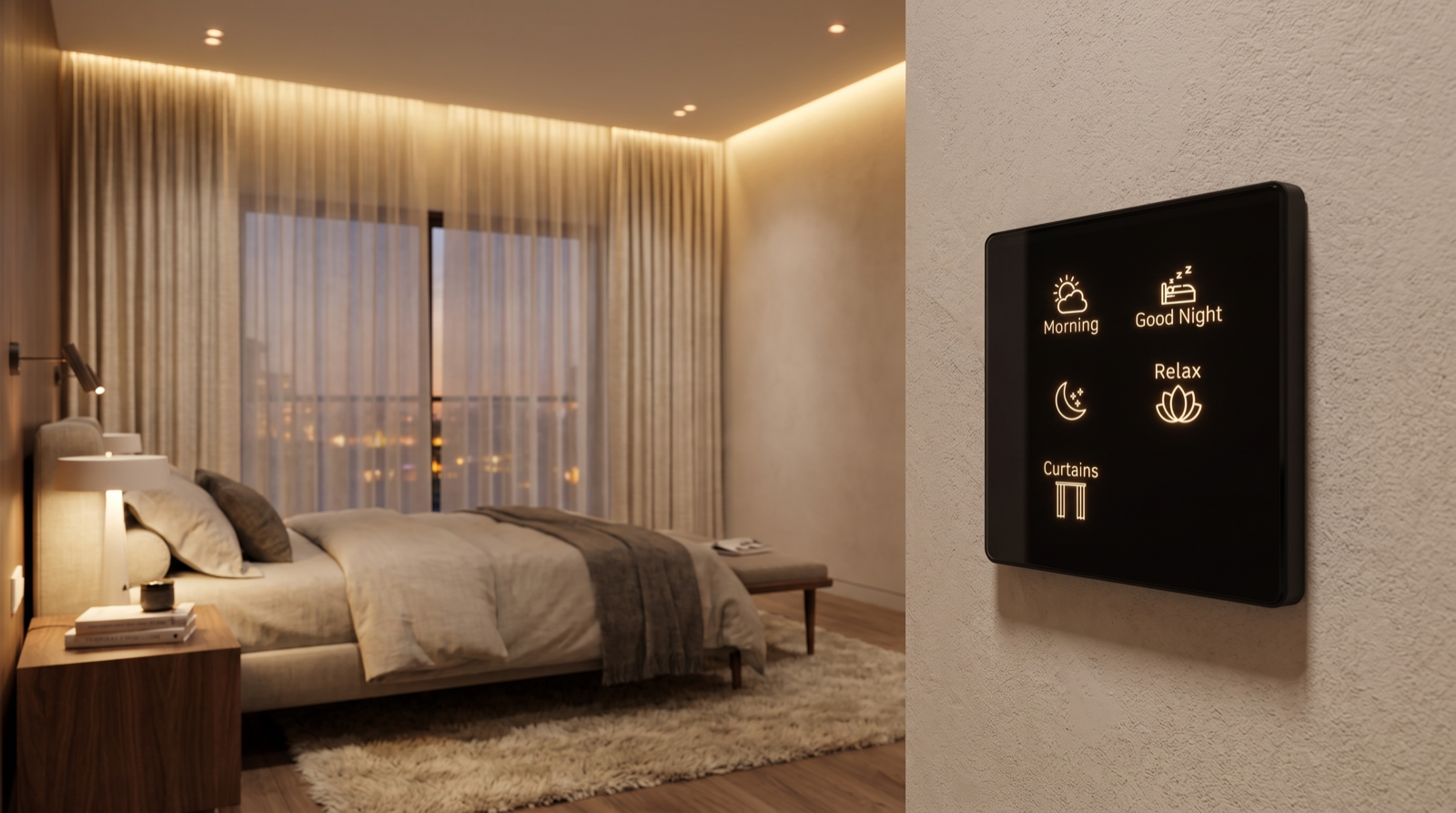
Once the fabric is right, the control layer is straightforward: the curtains join your lighting scenes rather than living in a separate app, so a single press on a Stella wall keypad can take a bedroom from Good Night — drape closed, tunable lighting down to 5% at 2700K — to Morning, with the sheer open and the drape stacked back. The worked levels for scenes like these are in how to design home automation scenes, and the button-count and engraving logic in keypad layouts and engraving. An Away scene that closes every motorised curtain in the house and arms home security in one press is, incidentally, the single most-used button in most of the homes we commission.
How Pert delivers it — a designed solution, not a DIY kit
Pert is a solutions company: we design and install, we do not hand over a box of parts and a manual. On curtains that means we sit in the conversation between you, your interior designer and your furnishing vendor rather than after it. We do a site visit and measure the actual opening, the available side wall and the finished floor level; we specify the track, the motor and the pocket against the fabric you have actually chosen, with the weight calculated rather than assumed; we issue dimensions the false-ceiling contractor and the furnishing vendor both work from, so the pelmet depth, the power point and the stack allowance agree with each other; we install and set the limits, overlaps and speeds on site; and then we commission the curtains into your scenes after the furnishing is hung, not before.
That last step is where motorised curtains are won. Limits set on a bare track are a guess; limits set with the real fabric on it, at the real floor level, with the overlap dressed by hand, are the reason a curtain still closes perfectly three years later. If you are still comparing providers, our guide to the best home automation companies in Hyderabad sets out what to check before you sign.
Choosing curtain fabric for a new home in Hyderabad? Send us the fabric details before it is cut — we will calculate the load, size the motor and track properly, and give your furnishing vendor the stack, return and hem dimensions in writing. It takes one conversation and saves the one problem that cannot be fixed afterwards. Request a consultation →
Frequently asked questions
How much weight can a motorised curtain track carry?
Most residential curtain track motors are rated between 25kg and 50kg, and the honest working figure is 60-70% of the rating rather than the number on the box. Calculate your load as track length × fullness × drop × (face GSM + lining GSM) ÷ 1000. A 3m track at 2.2× fullness with a 2.9m drop carries 19.1 square metres of cloth — about 8.6kg in a 300 GSM fabric with a 150 GSM lining, but about 15.3kg in a 550 GSM velvet with a 250 GSM blackout lining. The second one changes the track, the carrier spacing and the motor you should be quoting.
Should motorised curtains touch the floor?
No — leave 10-15mm between the finished hem and the finished floor. A manual curtain can puddle as a styling choice; a motorised one drags on every open and close, frays its leading edge, pulls out of square and makes the motor read friction as an obstruction. Measure the gap from the finished floor after tile or wood is laid, and check it at three points across the width, because floors in new construction are rarely level.
Can you use blackout curtains on a motorised track?
Yes, and bedrooms should have them — but choose a separate blackout lining rather than a coated blackout face fabric. Three-pass coated blackout is stiff at 350-500 GSM, holds a soft S-fold badly and stacks lumpy; a 200-300 GSM face fabric with a 150-250 GSM blackout lining is just as dark, drapes properly and can be replaced independently. Remember too that fabric alone does not make a dark room: you also need a closed pelmet, 100-150mm side returns and a 50-100mm centre overlap.
How much wall space do motorised curtains need to stack back?
Budget about 200-250mm of stack per metre of track for a medium S-fold at 2× fullness, 250-300mm for a pinch pleat or heavy fabric, and 150-200mm for a light sheer. A 3m centre-opening track therefore parks roughly 600-750mm of fabric, split at both ends. Extend the track 300-400mm past each side of the window onto solid wall so that bundle sits off the glass — otherwise you lose that much view and daylight permanently, and where only one side has spare wall, a one-way draw beats a centre-open pair.