
In this guide
This article is part of our wider coverage of home automation in Hyderabad. It builds on our guide to designing wake-up and bedtime routines, which assumes a conventional day; here we flip it.
Why default routines fail shift workers
A typical automated home has a handful of time-based assumptions built in. Each one becomes a problem when someone sleeps from 5 am to 1 pm:
| Typical default | What it does to a day sleeper | Better approach |
|---|---|---|
| Bedroom curtains open at 7 am | Floods the room with light an hour or two into sleep | Bedroom curtains follow the sleeper’s mode, not the clock |
| Alarm arms at 11 pm, disarms at 6 am | Triggers an alarm on the 3 am return | Arm with a button or mode; arrival handled with a user code and entry delay |
| Arrival lights at full brightness after sunset | Bright, cool light at 3 am just before trying to sleep | Low, warm path lighting between midnight and 6 am |
| House-wide “Morning” scene | Wakes the sleeper with lights or curtains in shared spaces | Room-specific scenes; the sleeper’s room is excluded |
| Notifications for every door and delivery | Phone pings all through the sleep window | Only safety alerts reach the sleeper during sleep hours |
A Day Sleep mode: what it should do
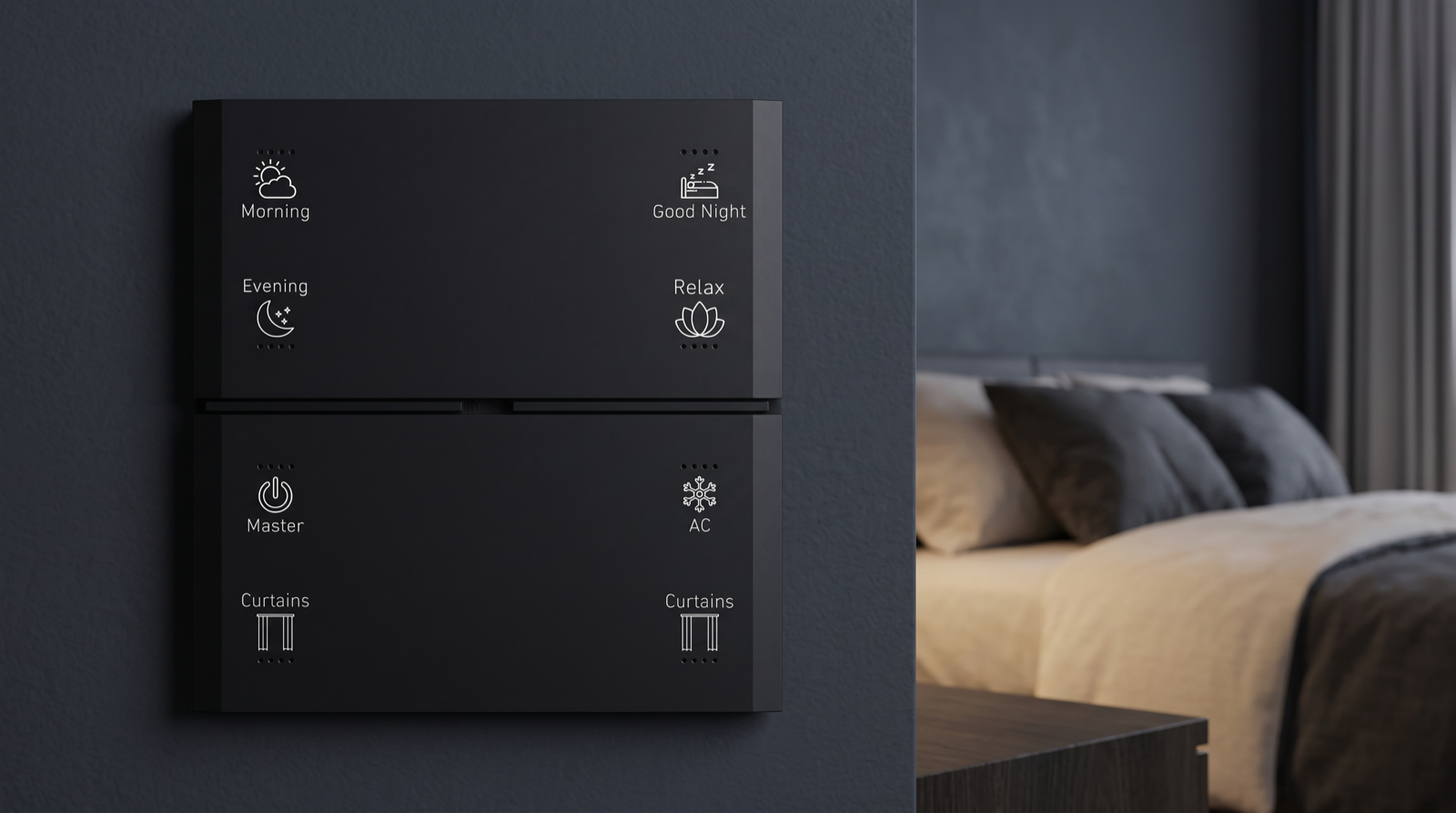
The cleanest solution is a dedicated mode for the sleeper’s room, triggered by a bedside button labelled for it or by the existing Good Night button. Modes change how the rest of the automation behaves, which is better than adding a dozen exceptions; our explainer on how home automation modes work covers the idea. A good Day Sleep mode:
- Closes the bedroom blackout curtains fully, and the sheers too if there are two tracks.
- Turns off the room’s main lights and sets any path light to its lowest night level.
- Sets the AC to the sleeper’s preferred temperature.
- Suspends every schedule that would touch the room: morning curtain opening, daylight shading, cleaning-time lighting.
- Silences non-urgent notifications to the sleeper’s phone, while still sending security and safety alerts.
- Ends with a wake-up action at a set time or when the sleeper presses Morning: curtains open gradually, lights rise slowly.
The key is that it is room-scoped. The rest of the household keeps its normal day.
Curtains and daylight: getting the room truly dark
Hyderabad daylight is strong for most of the year, and a bedroom that is “dark enough” at night is often far from dark at 11 am. Automation helps only if the hardware is right:
- Use blackout fabric with a lining on its own track, and keep the sheer on a second track. Motorise both so Day Sleep can close both.
- Mind the gaps. Light leaks at the top and sides more than through the fabric. A ceiling pocket or pelmet, curtains that overlap at the centre and extend 150–200 mm past the window on each side make a much bigger difference than a thicker fabric.
- Set exact limits. The motor’s closed limit must bring the two leaves fully together every time. Our guide to how motorised curtain automation works explains limits and positions.
- Wake to light gradually. Opening the sheer first and the blackout a few minutes later is gentler than both at once.
Coming home at 3 am: lights, lock and alarm
The return home is where a conventional system is most likely to misbehave. Design it as its own sequence:
- Unlock. The shift worker uses their own code or fingerprint on the smart lock, so the event is logged as them.
- Disarm. If the home is armed at night, entering their code at the door disarms the zones on their route, or an entry delay gives them time at the keypad. A fixed “disarm at 6 am” schedule is not the answer.
- Light the route, low and warm. Between midnight and 6 am, the door contact turns on foyer, passage and bedroom path lights at a low level and warm colour temperature rather than the full evening scene.
- Re-arm. Pressing Good Night or the Day Sleep button in the bedroom closes the curtains, turns off the route lights and re-arms the perimeter.
Our guide on arming, entry delays and alarm responses explains how entry delays and per-user codes work.
Living with people on a normal schedule
Most shift workers share a home with a partner, parents or children on a normal day. Keep everyone’s life easy with a few rules:
- No house-wide scenes that touch the sleeper’s room during their sleep window. The living room Morning scene should not open the master bedroom curtains.
- A shared indicator. Some households like the keypad outside the bedroom, or a family member’s app, to show that Day Sleep is active so nobody knocks or vacuums next door.
- House-help and deliveries. If the cook or cleaner arrives at 9 am, give them access that works without waking anyone, and route doorbell and delivery notifications to someone who is awake.
- Couples on different shifts. If one partner sleeps by day and the other by night, the bedroom serves two schedules. Bedside buttons on each side and scenes that only affect that side’s lighting help.
A sample schedule for a 6 pm to 3 am shift
This is an example for someone working a US-aligned shift from home or an office nearby. Adjust the times to your roster.
| Time | What happens | Triggered by |
|---|---|---|
| 3:30 am | Lock opened with personal code; foyer and passage path lights on at low, warm level; entry zones disarmed | Smart lock and door contact |
| 4:00 am | Day Sleep: blackout and sheer closed, lights off, AC set, schedules for the room suspended, perimeter re-armed | Bedside button |
| 7:00–9:00 am | Rest of the house runs its normal morning; sleeper’s room untouched; deliveries notify another family member | Normal schedules, room excluded |
| 12:30 pm | Sheer opens, then blackout a few minutes later; bedside light rises slowly | Day Sleep wake time |
| 5:30 pm | Study lights and AC on for the shift; curtains set against evening glare | Study keypad scene |
| Weekends | Day Sleep wake time moves later or is turned off; the household’s normal weekend schedules run | Weekend condition |
If the shift rotates, keep the mode the same and change only its wake time, rather than rebuilding rules every month. For more on schedule logic, see time, sunrise and sunset routines.
How Pert delivers it — a designed solution, not a DIY kit
Pert designs the home around the way your household actually lives, including when someone sleeps by day. We plan the blackout and sheer tracks for motorised curtains, set up tunable and dimmable lighting for low, warm night paths, label Stella keypads for the scenes you will use, and configure smart locks, sensors and alarms so a 3 am arrival is calm rather than a false alarm. Everything runs on one Zigbee network through the Pert gateway, with modes and schedules running locally. Our team installs, commissions and adjusts it after you move in. When you compare installers, our guide to the best home automation companies in Hyderabad covers what to ask.
Working nights and sleeping by day? We design and install lighting, curtains, keypads, scenes and security for apartments and villas across Hyderabad, and can set your home up around your shift. Request a consultation →
Frequently asked questions
Can smart curtains make a bedroom dark enough to sleep during the day?
Yes, if the hardware is right. Use a lined blackout fabric on its own motorised track with a sheer on a second track, a pelmet or ceiling pocket to stop light leaking at the top, and curtains that overlap at the centre and extend past the window on both sides. The motor's closed limit must bring the leaves fully together every time. Automation then closes both layers with one press.
How do I stop the security alarm going off when I come home at 3 am?
Do not rely on a fixed disarm time. Give the shift worker their own code or fingerprint on the smart lock and use an entry delay or code-based disarm for the zones on their route, so their arrival is logged and expected. When they press the bedside Good Night or Day Sleep button, the perimeter re-arms.
Will a day sleep routine disturb the rest of my family's schedule?
Not if it is scoped to one room. A Day Sleep mode should only suspend the schedules and scenes that touch the sleeper's bedroom, while the rest of the house runs its normal morning. House-wide scenes should exclude that room during the sleep window, and doorbell and delivery notifications should go to someone who is awake.
What lighting is best when coming home late at night?
Low and warm. Between midnight and early morning, have the door contact turn on only the foyer, passage and bedroom path lights at a low level and a warm colour temperature, instead of the full evening scene. It is enough to move safely without bright light just before sleep.