
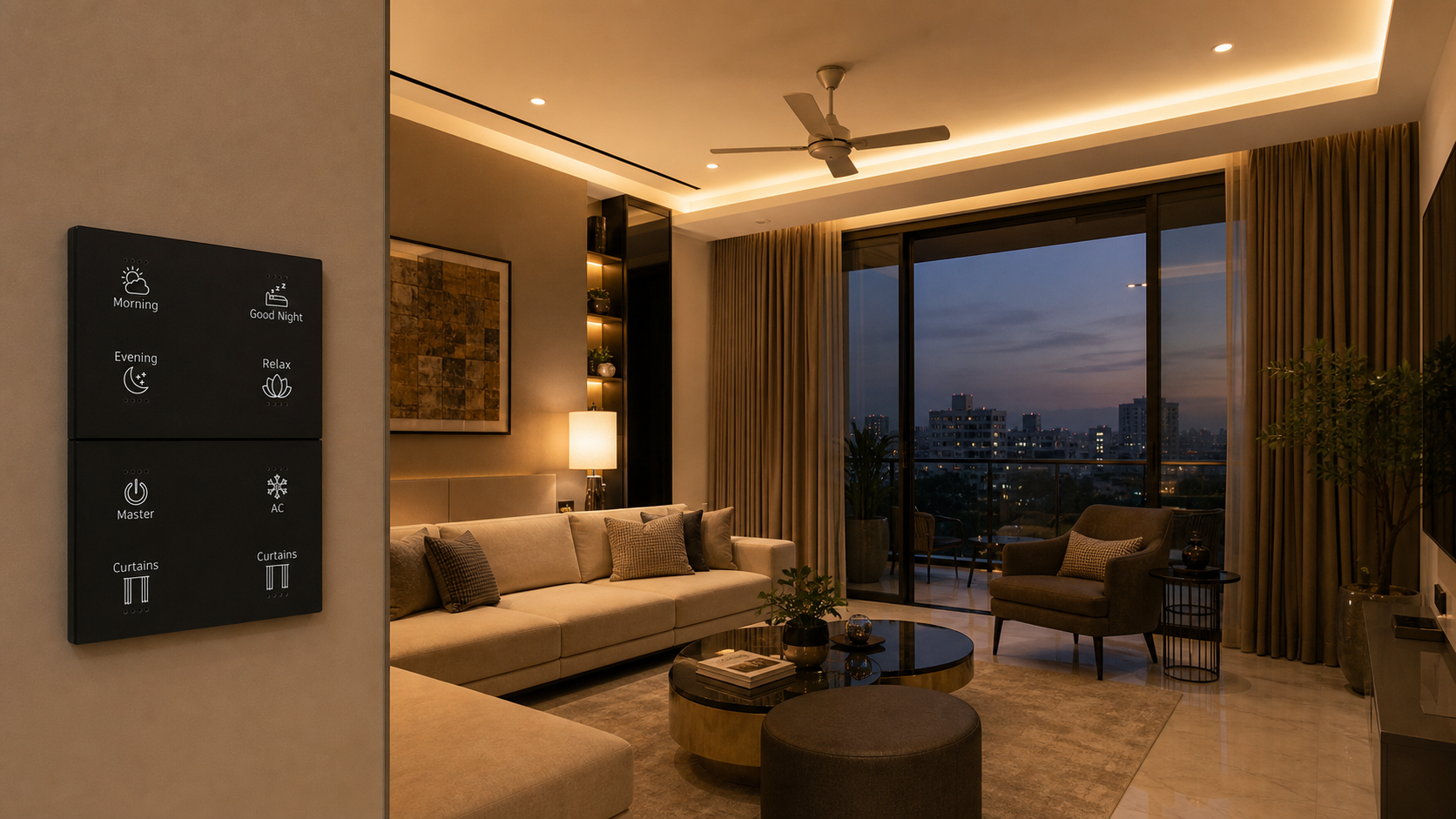
A lot of homeowners ask whether home automation increases resale value before they commit to lighting scenes, curtain control, keypads, and security planning. The practical answer is yes, but only when the automation improves daily usability and feels well integrated into the home.
If the system is overcomplicated, app-dependent, or badly planned, future buyers may see it as maintenance risk rather than added value. If the system is intuitive, reliable, and aesthetically aligned with the house, it can strengthen both buyer perception and premium positioning. For the broader category overview, start with our main home automation guide.
Where home automation adds value most clearly
Home automation adds the most value when it improves the way a home feels and functions every day. Buyers usually respond to outcomes, not technical specifications.
- Better ambience through smart lighting and scenes
- Cleaner control through bedside and entrance keypads
- More premium living through curtain automation and comfort scenes
- Stronger daily convenience from one-touch all-off and welcome-home logic
- Improved security perception through integrated access and monitoring
Buyers value simplicity more than feature count
A home with five practical scenes is usually more attractive than a home with twenty disconnected smart devices. Buyers care about whether the home feels calm, well resolved, and easy to understand.
That means the highest-value automation features are usually:
- Scene-based lighting control
- Well-placed wall keypads instead of app-only control
- Curtain and lighting integration in living rooms and bedrooms
- Reliable AC or comfort logic in key spaces
- Security that feels integrated, not added as an afterthought
Smart lighting often creates the strongest premium impression
Among all automation categories, lighting usually changes buyer perception the fastest. Good lighting scenes make the home feel more expensive, more intentional, and more comfortable. They affect every viewing, every evening atmosphere, and every key living space.
That is why lighting-led automation often gives the strongest visible return. Read: How Smart Lighting Is Changing Home Interior Ambience and Tunable and Dimmable Lights.
Keypads matter because they make the system usable
Future buyers rarely want a home that depends entirely on an app. They want a home that feels natural. That is why wall controls matter so much for resale value. Good keypad planning makes the system understandable from the first day.
Useful examples include:
- Entrance keypad with welcome and all-off scenes
- Bedside keypad for night, curtains, and comfort
- Living-room scene control for evenings and entertaining
- Dining-space lighting scenes for mood and hosting
Related: Stella Keypad and How to Plan Keypads in a Home.
Which homes benefit most from resale-oriented automation?
Not every property needs the same scope. Value comes from fit, not from maximum device count.
- Villas benefit from deeper scene planning, broader lighting strategy, and layered comfort/security control
- Apartments benefit from elegant lighting, curtains, and simple room-by-room control
- Premium renovations benefit when automation is integrated into redesigned interiors instead of added later
See: Best Home Automation in Hyderabad for Villas and Home Automation for Villas vs Apartments.
What usually does not add much value
Some smart-home features sound advanced but do not meaningfully improve resale appeal unless they are part of a coherent system. Buyers are rarely impressed by novelty alone.
- Too many isolated smart plugs and app-only gadgets
- Overly technical interfaces that require explanation
- Systems that stop feeling usable without internet
- Features that are difficult to maintain or service
- Automation that conflicts with the interior aesthetic
Planning quality affects value more than brand count
A well-planned system increases value because it feels built into the house. That requires early decisions around lighting zones, curtain provisions, keypad locations, Wi-Fi access points, and control logic. If those decisions happen too late, the result often feels compromised.
Read: When Should You Plan Home Automation During Construction? and Can You Add Home Automation During Renovation in Hyderabad?.
Does home automation help only resale, or also day-to-day value?
Most homeowners should think in terms of both. A home automation system creates value first through everyday use: better ambience, better routines, easier control, and smoother mornings and evenings. Resale value becomes stronger when those daily improvements are visible and believable to the next buyer.
That is why scene-based living tends to outperform gadget-heavy setups. Related: Why Scene-Based Automation Is Better Than App-Only Smart Devices.
How to make sure automation stays attractive to future buyers
- Keep the control logic intuitive
- Prioritize lighting, curtains, comfort, and security over novelty devices
- Make sure the system works practically even without internet for core local control
- Choose a setup that is easy to maintain and service
- Work with an integrator who understands daily usability, not just installation
If you are comparing providers, read How to Compare Home Automation Companies in Hyderabad on Service, Not Just Price.
Final thoughts
Yes, home automation can increase property value, but the value comes from quality of living, not from gadget count. The homes that benefit most are the ones where automation improves lighting, privacy, comfort, security, and control in a way that feels natural to the next owner.
If you want the best chance of turning automation into long-term value, plan around scenes, usability, and integration quality. Start with the main home automation guide or talk to Pert about your project.
FAQ
Does home automation increase resale value?
It can, especially when it improves lighting, comfort, security, and overall ease of living in a way that feels intuitive to future buyers.
Which smart-home features add the most property value?
Smart lighting, scene-based controls, curtain automation, practical comfort control, and integrated security usually add the most visible value.
Do app-only devices help property value?
Usually less than integrated scene-based systems. Buyers tend to value homes that feel simple and usable, not homes that require multiple apps.
Is home automation worth adding before selling a house?
It depends on the property and scope. Focus on visible, practical upgrades like lighting scenes, keypads, and curtain control rather than complex overhauls.
What reduces the value of a smart-home system?
Poor planning, complicated controls, weak maintenance support, and disconnected gadgets can reduce buyer confidence instead of increasing value.