
In this guide
This article is part of our wider coverage of home automation in Hyderabad. For a broader look at wireless options, read our comparison of Zigbee, Wi-Fi, Bluetooth Mesh and Matter. This one focuses on the question villa owners ask most: a wired KNX bus or a wireless Zigbee mesh?
How each system works
KNX: a wired bus with decentralised devices
KNX is an open international standard (ISO/IEC 14543-3) supported by hundreds of manufacturers. In its common form, every KNX device — keypads, dimmer and switching actuators, curtain actuators, sensors — connects to a dedicated two-core bus cable (usually the green KNX cable) that carries both low-voltage power and data. The bus runs from a power supply in the distribution board to every keypad and sensor in the house.
KNX is decentralised: each device stores its own part of the programming. A keypad sends a message on the bus, and the actuators in the panel that are configured to listen to it respond. There is no single “brain” the house depends on for basic control. KNX also exists in radio (KNX RF) and IP forms, but villas are usually specified with the wired bus.
Zigbee: a wireless mesh through a gateway
Zigbee is an open wireless standard built on IEEE 802.15.4, running in the 2.4GHz band. Devices talk by radio, and every mains-powered device (keypads, lighting controllers, curtain motors) also acts as a router, relaying messages for others. That forms a mesh: if one path is blocked, messages take another. A gateway acts as the coordinator, holds the network together and runs scenes, schedules and automations locally in the home. Battery sensors and locks join as end devices that sleep most of the time. Our explainer on how a Zigbee mesh network works covers this in detail.
The important practical difference: a Zigbee device needs power where it sits, but no control cable back to a panel. A KNX device needs the bus cable to reach it.
Head-to-head comparison table
| Factor | KNX (wired bus) | Zigbee (wireless mesh) |
|---|---|---|
| Medium | Dedicated bus cable to every device | 2.4GHz radio; mains devices relay for each other |
| When you must commit | Before conduits are closed and walls plastered | Can be designed later; needs neutral and correct box depths |
| Effect of concrete walls and slabs | None; signals travel on cable | Real; handled by planning router devices on each floor and near the gateway |
| Central point of failure | No single brain for basic control; bus power supply is critical | Gateway runs scenes and schedules; keypads still need it for most functions |
| Programming | ETS software, by a trained integrator | Gateway app and installer tools; changes made by the installer or, for simple items, the owner |
| Adding a keypad later | Needs the bus cable to reach that wall | Usually just a powered box and pairing |
| Main cost drivers | Actuator channels, bus cabling, panel space, integrator programming time | Devices per point, gateway, design and commissioning |
| Multi-brand choice | Very wide; certified devices interoperate | Wide in theory; in practice best within one designed ecosystem |
| Typical fit | New-build large villas with a committed architect and integrator | New builds and renovations, apartments and villas |
Construction timing and cabling
This is where the two differ most for a Hyderabad homeowner. A KNX villa is designed early: the bus has to be drawn into every keypad and sensor location, and lighting and curtain circuits are usually run back to actuators in a larger distribution board. Once the walls are plastered and painted, adding a KNX keypad where no bus cable exists means chasing walls or using a radio variant.
- KNX needs: a bus cable route to every control point, extra space in the distribution board (often a separate automation panel) for actuators, and the lighting circuits laid out so each controllable group comes back to its own channel.
- Zigbee needs: a neutral wire in each switch box, boxes deep enough for the control module, and a sensible place for the gateway near the router on inverter-backed power. Lighting and curtain loads stay on normal circuits.
That is why many villas that are already plastered, or where the automation decision comes late, go wireless. Our guide on when to plan home automation during construction covers the timing in more detail, and the electrical points checklist lists what to leave before plastering whichever route you choose.
Reliability in a concrete villa
KNX’s biggest advantage is that radio conditions do not matter. A message on a cable reaches its destination whether the wall is brick, RCC or stone cladding. A well-installed KNX bus is extremely dependable.
Zigbee’s reliability comes from design rather than the medium. RCC slabs and shear walls weaken 2.4GHz signals, so a G+2 villa needs enough mains-powered router devices on each floor and in the stairwell to bridge the floors, a gateway placed centrally rather than in a corner, and a Zigbee channel chosen with the home’s Wi-Fi in mind. Done that way, a Zigbee villa is reliable day to day. Done carelessly, with one gateway in a ground-floor cupboard and battery sensors on the top floor, it will not be.
| Risk | KNX | Zigbee |
|---|---|---|
| Signal through RCC floors | Not applicable | Solved with routers per floor and stairwell |
| Wi-Fi congestion | Not applicable | Solved with channel planning |
| Damaged cable during later work | Can take out a section of the bus | Not applicable |
| Power cut and inverter changeover | Bus supply should be on backup | Gateway and router devices should be on backup |
| Internet outage | No effect on local control | No effect when scenes run locally on the gateway |
Programming, changes and who can service it
KNX is programmed in ETS, a licensed software tool, by a trained integrator. The project file is the system: whoever holds it can modify the house. Ask for a copy at handover, because without it another integrator has to rebuild the configuration by reading devices one at a time. Small changes, such as moving a light to a different button, are an integrator visit.
Zigbee systems are programmed through the gateway: devices are paired, grouped and assigned to buttons and scenes in the installer’s tools and the app. Changing a scene or schedule is usually quicker, and simple changes can often be made by the homeowner. The trade-off is that the configuration lives in one ecosystem; it is the installer’s documentation and the gateway backup that make it serviceable later.
Either way, the questions to ask are the same: who holds the configuration, is it documented room by room, and who will support it in five years.
Where RS-485 and hybrids fit
RS-485 is a wired serial link, often used to control curtain motors, some AC gateways and certain proprietary panels. It is robust over long runs, but it is a connection method rather than a complete home automation standard, and each manufacturer defines what travels over it. In a villa it usually appears as one part of a bigger system, for example curtain motors wired to a controller.
Hybrids are common in practice: a KNX core with Wi-Fi cameras and a separate lock app, or a Zigbee system with a few wired elements. Hybrids work when one gateway or controller ties them together and one company is responsible for the whole. They become painful when each part has its own app and its own installer.
Which one for your villa
| Your situation | Usually the better fit | Why |
|---|---|---|
| New build, structure only, architect and integrator engaged early, large budget | KNX is a strong option | The cabling can be planned in; you get a wired, multi-vendor system |
| New build, decision being made during or after plastering | Zigbee | No bus to every point; needs neutral and box depth, which are easier to provide |
| Finished villa or renovation | Zigbee | Avoids chasing finished walls and ceilings |
| You expect to change layouts or add rooms often | Zigbee | Adding a keypad or sensor is far less disruptive |
| You want the widest choice of brands over decades | KNX | Certified devices from many makers interoperate on the same bus |
| You want scenes, curtains, lighting and security in one app with quick changes | Zigbee through one designed system | One gateway, one app, one installer |
Neither is “better” in general. KNX rewards early commitment and a specialist integrator; Zigbee rewards good radio design and gives you more flexibility. For more on what makes a villa system worth it, see the best home automation for villas in Hyderabad, and when you shortlist installers, our guide to the best home automation companies in Hyderabad lists what to ask.
How Pert delivers it — a designed solution, not a DIY kit
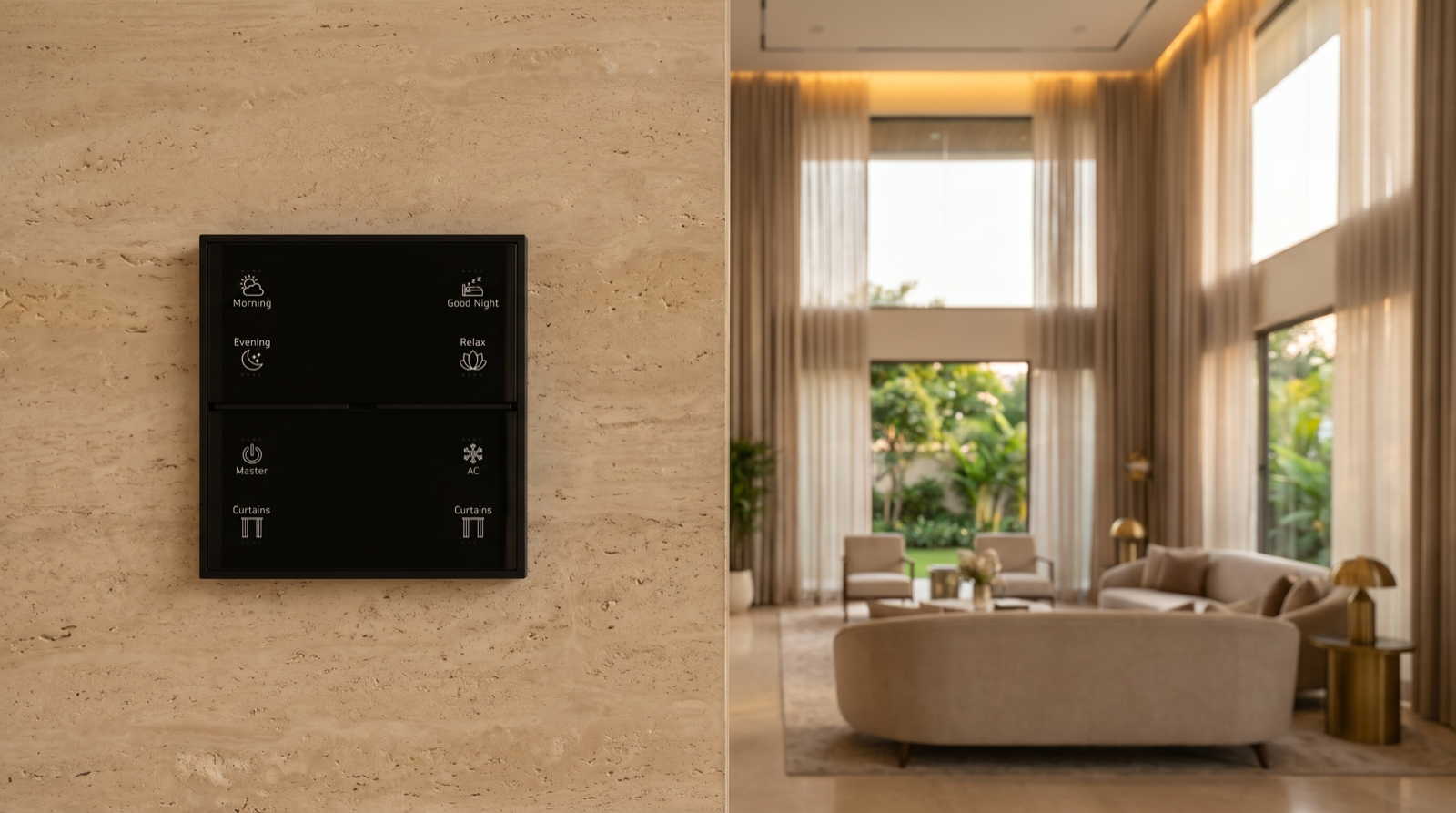
Pert chose Zigbee because it suits the way most Hyderabad homes are actually built and finished: it lets us bring automation to villas and apartments without running a control cable to every wall, it is an open standard with low-power battery devices for sensors and locks, and with proper mesh design it is reliable through concrete. Our Stella keypads, tunable and dimmable lighting, motorised curtains and security devices all work together on one Zigbee network through the Pert gateway, with scenes and schedules running locally in the home.
We design every villa floor by floor: where the gateway sits, which devices route between floors, which circuits need neutral, and how each keypad maps to scenes. Then our own team installs, commissions and documents it. If your architect has specified KNX, we will tell you honestly whether Zigbee suits your project or not.
Deciding between wired and wireless for your villa? We design and install lighting, curtains, keypads, scenes and security for villas and apartments across Hyderabad, and we can walk through your drawings floor by floor. Request a consultation →
Frequently asked questions
Is KNX more reliable than Zigbee?
KNX does not depend on radio, so walls and Wi-Fi congestion never affect it, and a well-installed KNX bus is extremely dependable. A Zigbee system can be reliable day to day too, but only when the mesh is designed properly: enough mains-powered router devices on every floor, a centrally placed gateway on backup power and a Zigbee channel chosen around the home's Wi-Fi. The difference is that KNX reliability comes from the cable, while Zigbee reliability comes from design.
Can KNX be added to a villa that is already plastered?
Only with difficulty. Wired KNX needs the bus cable to reach every keypad and sensor, which means chasing finished walls, or using KNX radio devices for some points. That is why villas that are already finished, or where the decision comes late, usually choose a wireless system such as Zigbee, which needs only a neutral wire and a deep enough box at each switch location.
Is KNX more expensive than Zigbee?
Usually, for a comparable home, because KNX adds bus cabling to every point, more panel space for actuators and specialist programming time in ETS. Zigbee costs are driven mainly by the devices at each point, the gateway and design and commissioning. The exact difference depends on the number of circuits, curtains and keypads, so compare full quotations for the same scope rather than per-device prices.
Why did Pert choose Zigbee instead of KNX?
Because it fits the way most Hyderabad homes are built and finished. Zigbee needs no control cable to every wall, so it works in new builds, finished villas and apartments alike; it is an open standard with low-power battery options for sensors and locks; and with good mesh design it is reliable through concrete. Pert keypads, lighting, curtains and security devices all run on one Zigbee network through the Pert gateway, with scenes and schedules running locally.